@leo@wattenberg.dk
This episode starts like it always starts: A publisher announces a new game. The new game is apparently different to the previous game, and that’s a complete dealbreaker. How could they?? In this case the game is Civilization 7, and the change in question were, well, I’ll get there.
Just for fun, I decided to spend some time in the salt mine that are the comment sections for this announcement. There are some hilarious capital-G Gamer moments on full display, and I could spend an entire blogpost ridiculing all of them. But just to give a little taste of them:
Wow… I never would have imagined the narrator to be a woman. And a female Pharaoh! Who would have guessed. Ooo… I can’t wait for the trans non binary queen!!
— @theendishere7, who has never seen the Wikipedia Category:Female pharaohs
But the most common whinge here isn’t how women ruin gaming, or how Firaxis lost the plot in daring to simulate climate change, no, it was that, rather than leading the United States of America from 4000 BC to 2050 AD, you instead evolve it from an ancient civilization to a modern one.
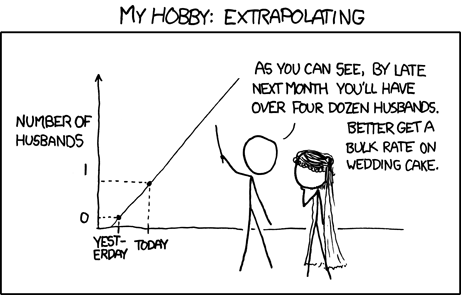
And to be fair, there are concrete reasons to be concerned about this change: Humankind (2021), a game heavily inspired by Civilization, attempted this previously, and that game was somewhat lackluster in its execution. And given that “game with civilization change is meh” is the only data point, it’s easy to extrapolate from there that Civilization 7 is going to be meh as well.
https://imgs.xkcd.com/comics/extrapolating.png
Luckily for us, the board games Small World (2009), Vinci (1999) and History of the World (1991) also all had such a feature, each of which won several game of the year awards. So the concept itself probably can be executed well, it’s just that Humankind couldn’t.
Yet, the backlash to this change is suspiciously disproportionate. This isn’t just people being skeptical about a gameplay change. This goes deeper, with some stunning language:
The changing mechanic is disgusting. It tries to imprint on us that all people are interchangeable.
— @Aemond2024
Yep, this is about nationalism.
Even though nationalism is a fairly recent addition to the list of things humans get very attached to and excited about, only really becoming a thing throughout the 19th century, it probably is the most popular belief system at the moment.
Up until now, Civilization 1-6 consisted of you leading a civilization – current nations like Germany, France or Russia, or ancient civilizations like ancient Rome, Aztecs or Maya. Each civilization has some perks unique to it: For example, China is the only civilization which can build the Great Wall as its tile improvement, and is the only one to have the Crouching Tiger unit. Unless conquered, each civilization is eternal.
This gameplay is inherently compatible with nationalism. In nationalism, a large source of pride is the achievements of others of the same nationality, whether it’s someone good at sports in the Olympics, or something someone did in the old times.
These nationalist beliefs are just that though – beliefs.
In Civilization 7 meanwhile, you play as 3 somewhat connected, but different civilizations through out the ages: the ancient era, age of exploration and modern age. This completely rips apart this idea of nations as a practically eternal thing – easy to understand and drastic to see. The idea of a people being not a constant, but rather changing over time is just incompatible with nationalism. But it also is true.
Take the kingdom of Majapahit under the rule of Tribhuwannottunggadewi Jayawishnuwardhani (or just Gitarja if you don’t have that much time). In Civilization 6, it is practically a nation from 4000 BC to 2050 AD, like the all the other ones. And while in the back of our head we know this isn’t quite how history played out, from a nationalist background this feels like an acceptable simplification to make.
Let’s now take a look how Civilization 7 might structure this instead: In the 3-era model, Majapahit just barely makes the cut for the ancient era. Once we hit the age of exploration, we’re offered the choice to become Chinese or… Dutch? That’s like on the other side of the world! And for the modern era, it’s a choice between Germany, Britain, Japan and Indonesia! Surely, none of that makes any sense?
As it turns out, all of it does:
Any choice here is, in an alternate history sense, reasonable in the simplified model we’re operating under. And it’s not like it’d be a massively strong detriment to Civilization as a series if the choice was _un_reasonable: Civilization is not a game series which cares particularly about historical accuracy. After all, in Civilization 6, the following scenario is possible:
A Buddhist France declares war against a Custom Religion United States of America because both spawned on Antarctica (which consists of mountains and plains mostly, with a bit of desert) in the year 200 AD, and are only separated by the city-states of Jerusalem (allied with France with 4 envoys) and Auckland (allied with the United States with 3 envoys). By the time the war ends in 950 AD, Auckland is captured by France and subsequently lost as a Free City due to low loyalty, but Jerusalem and Bordeaux get converted to Custom Religion. The Catholic Phoenicians swoop in and conquer the Free City of Auckland with its vampires, and to maintain loyalty complete the Move Capital project in Auckland.
If you’ve never played Civilization 6 before, the above paragraph is insane. If you have, you might have done something similar before without batting an eye, and if you’ve played with friends, you probably wouldn’t be surprised if the next step of France and the US would be an alliance and a joint declaration of war against Phoenicia to rid the world of that dirty opportunist.
And it’s finally with this backdrop that the decision to switch civilization mid-game is hardly outrageous at all. If anything, it adds realism if you go with the maximum realism option provided (which might even be a Roman Empire -> Holy Roman Empire -> Germany path!), and gives player choice if you find your empire developing in a vastly different direction compared to reality. And on the way it just casually happens to challenge nationalism, without even drawing much attention to that.
4 years ago, I wrote a blog post on the VTuber scene. Since then, I’ve learned a lot. Let’s go through the old thing once more. I will go through the old post chronologically, but putting the section on umbrella brands (Hololive, Nijisanji) at the end, because… well. If you have paid attention to the scene, you’ll know why.
/2020/07/08/observations-of-the-vtuber-scene
I wrote that the benefits of VTubers are full privacy (in principle) while maintaining facial expressions and having an more-interesting-than-average brand.
All of these things principally are still true. If anything, the facial expression bit has increased a lot, both hardware and software has become better and more affordable. I also have seen the models themselves improve in recognizability, especially among independent VTubers. While Chibidoki’s old model was somewhat easily confused with… any pink chibi girl, really, her new ones are a lot more distinct and, well, “deranged”, unique to her.
Last time I wrote that formats matter, with non-game and non-just-chatting streams having a big future ahead of them. This has proven true, with more new formats like cooking shows (Onigiri) and straight-up IRL streams becoming more prevalent among VTubers. As it turns out, being a 2D cardboard cutout is quite limiting in what you can do as content, and being able to switch between 2D, 3D and IRL depending on content has proven to be quite an interesting mix.
Highlights and clips still matter immensely, they certainly do for my personal consumption of this content as I no longer have the time to watch streams for hours on end. Interestingly, there doesn’t seem to have been a major shift in the implement clips on official channels. This effort remains almost entirely fan-driven.
The streaming platform market has changed immensely. Back when I wrote the blog, there was a 4-way race between Amazon (Twitch), Google (YouTube Gaming), Microsoft (Mixer) and Facebook (FB Gaming) to attract talent and gain dominance. One could say it was the only time any of these platforms have paid talent fairly. Today, all of these companies have gotten bored of streaming: Microsoft shut down Mixer, Amazon is shutting down Twitch in areas they deem too expensive to serve, and generally trying to distribute computing load onto the streamers rather than themselves, Facebook seems to bumble around aimlessly as the Metaverse wasn’t the next big thing they hoped it would be, and Google shut down the “gaming” bit of YouTube Gaming, though YouTube live continues to receive technically perhaps impressive but ultimately extremely boring features. The only other platform of note is Kick, a streaming site with casino backing specifically targeting gambling streamers and hoping to get the masses gamble more. Previously, YouTube was technically the best platform to stream to with Twitch being culturally the best one; today, it seems like YouTube is the only platform to stream to which has any hope of surviving for another 5 years.
Sexuality remains a massive draw to the VTubing scene, and the entirety of anime-esque content for that matter. Previously I wrote that I found this an easy, yet effective way to generate interesting content; today it feels like “empty calorie fast food”. That is to say, even in cases where “haha booba funni”, it no longer feels like meaningful content I want to engage with. That is more of a comment on myself than it is on the content, but I do wonder: What if anime-esque content wasn’t this horny all the time? What if Goddess of Victory: Nikke, which I am assured has an amazing story, actually was a story-driven game, rather than an ass jiggle simulator designed to pull money out of your pocket so you can watch more asses jiggle?
There has been not much change in VTubers typically posting daily and live content. Again, not something bad per se, but worth noting that almost none do anything else. Perhaps this explains the incredible rise of Filian, who outside of organizing the VTuber awards also posts 10-20 minute videos on her channel once or twice a week.
And now for the section that I promised in the beginning:
I wrote previously that umbrella brands are immensely powerful. This is still true; Hololive has an amazingly strong pull as a brand. I had criticized Nijisanji last time for not having as strong of an umbrella brand, both due to a wider focus and talent pool, and some more technical issues. When I wrote that blogpost, I got a lot of pushback on that. But looking back at that - I was right. And holy fucking shit do I wish I wasn’t.
Nijisanji went public in 2022. At the time, they had 107 VTubers (or, as we in the showbiz say: talent), with an excellent retention rate of 97%, and set out with lofty goals:
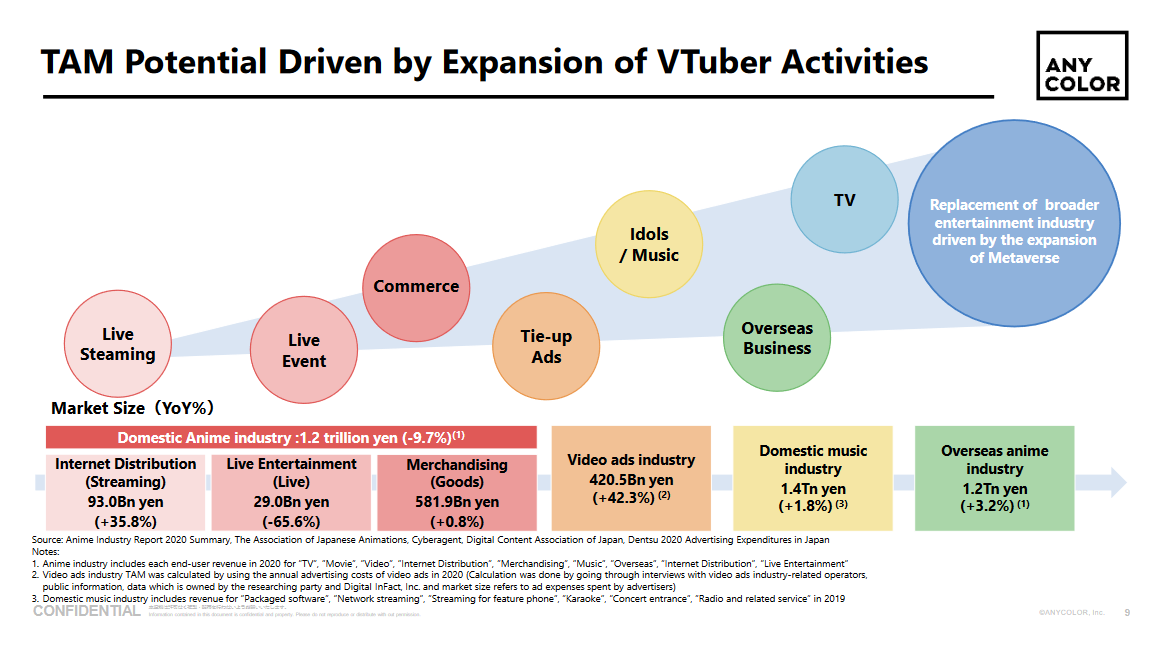
Via https://www.anycolor.co.jp/en/ir/news
Today, Nijisanji would have 257 talent in total, except a quick counting on the Wikipedia shows that 81 left the company or have been on hiatus for years. Which leaves us with 176 still in the company, and a retention rate of 68.5%. Again, this is down from 97% retention.
From talent who quit or got forced out, horror story after horror story are brought to light: Unpaid invoices, unpaid taxes, extremely one-sided contracts, workplace abuse, a general lack of interest from the company into talent, a lack of funding, prohibitions to develop the content further, and much, much more. Nijisanji is being labeled a “Black company”, a shady sweatshop, today.
Nijisanji is trying to control the damage the same way as any failing company: By buying back stocks. 1 billion yen they already spent on stock buybacks in the first half of January 2024, with another 1.5 billion yen being promised for later. And despite that, their stock price has plummeted from an all-time high 6500 yen per share in late 2022, to almost an all-time low of 2100 yen per share today.
And while I can’t claim that I fucking called it, I have seen it before. I even mentioned it in my previous post:
These umbrella brands are fairly rare on YouTube these days. For me, only Machinima comes to mind.
And Nijisanji is following Machinima’s playbook almost to a T.
Machinima is one of the earliest multi-channel networks. They got an umbrella brand going, got a lot of creators on it (5000!), had shitty, one-sided perpetual contracts, wanted and eventually reached the big leagues when they got bought by Warner Bros, and collected massive profits throughout as they would take 40% of their partners’ income without actually doing all that much in return. They went bust in 2019, when YouTube started tightening quality requirements for MCNs.
Nijisanji’s talent won’t be so lucky. Their identity is stuck with the company, and as they avoided the MCN framework, there is no YouTube which can swoop in. There also is no sign, externally anyway, that Nijisanji is set on changing in any way. Reading through their initial sales pitch to investors, they proudly present how their operating profit margin grew from 1 to 30% between 2020 and 2022, and their strongarm position in owning IP is listed as a “unique competitive” advantage of theirs.
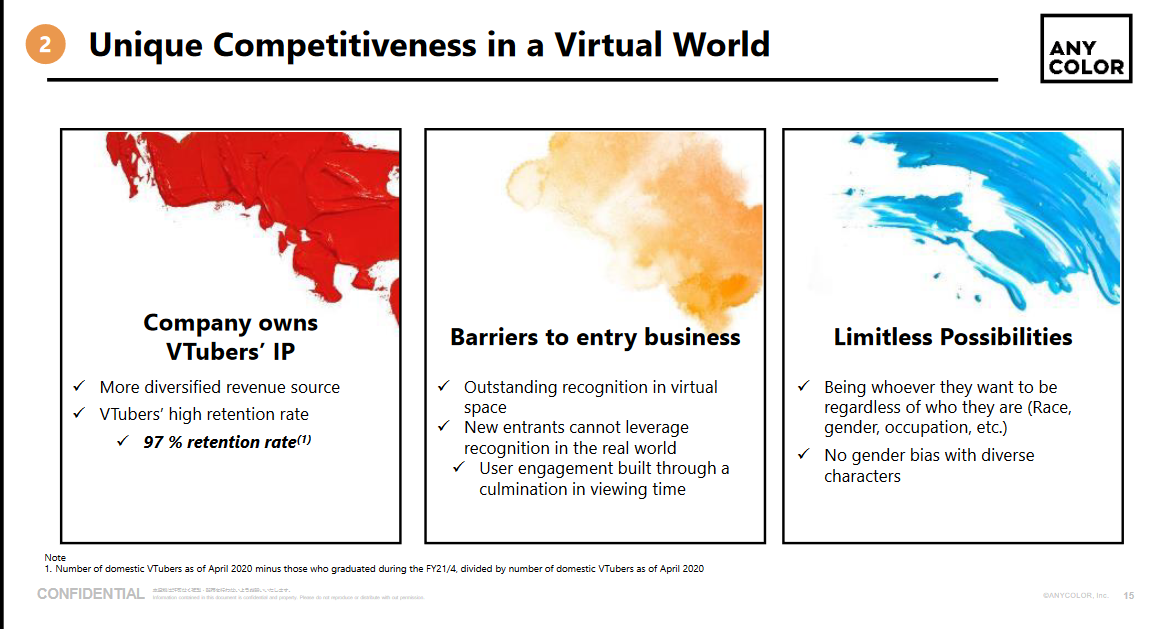
A slide proudly proclaiming "company owns vtubers IP"
And they have not issued any public statement that they changed their mind on that. On the contrary, when Dokibird / Selen Tatsuki quit Nijisanji and aired her grievances, they issued a statement that merely read: “The impact of this decision on our financial results will be negligible”.
Will Nijisanji die? Probably not. They can just keep firing managers until they’re profitable again. In their ideal world, they’d need 0 managers and have talent pay for them anyway. Should they die? Probably yes.
If you are talent, there are two ways of avoiding ending up in a Machinima/Nijisanji situation
I live in a village located in the so-called “rotten banana” of Denmark, that is, the banana-shaped area of Denmark which swoops around the economic powerhouses of Copenhagen, Aarhus and Odense.
There is not much in the village anymore, the supermarket which used to be here closed last year, the school has been closed for much longer, and the old train station hasn’t seen operation in living memory. All that remains is a church from the 12th century, a bunch of old people who came here back when jobs existed in this area, and lots of farming on all sides. “Rotten” really is the term to use here. Rotten, cheap, but somehow with very affordable gigabit internet, which makes everything worthwhile for the modern work-from-home employee. (If living in Denmark or a rural area appeals to you at all, do come here!)
As a work-from-home person, I’m physically somewhat unfit, think your typical IT/software/deskjob person who doesn’t do sports.
Getting stuff is varying levels of difficult: Groceries I can either get from the farmer himself, or from a small supermarket 2 villages over, both being some 5km away. The nearest town is 20km away, but some services are in a more distant town at 30km away and if I actually need to get some real specialty stuff, the next city is 60km off.
Deliveries are an option, though international delivery companies (UPS, DHL, etc) have a tendency to not bother actually driving out to here, but instead doing the “sorry we missed you” thing via email - so no need for them to get anywhere near me. If that happens, the package ends up at aforementioned supermarket.
Food deliveries are a thing too, though the choices are between 2 restaurants: “generic asian” (with the standard chinese, thai, vietnamese dishes) and “generic western” (burger, pizza, kebab). The quality is predictably mediocre and the temperature predictably lukewarm when it arrives. As they have a pretty tight window of opening hours, they’re by no means lifesaver that you get in cities if you get the munchies in the middle of the night.
I have lived like this for a year and a half and can quite comfortably say:
I don’t need a car.
My eBike is a RadPowerBike RadCity 5 Plus, for which I would plop an affiliate link here, but I don’t have one as they have focused on operating in the US only nowadays. It’s the slow kind of eBike, officially called “pedelec”, limited to 250W and 25 km/h speeds, which mustn’t have a throttle.
There’s a faster kind too, the “s-pedelec”, which is limited to 45 km/h and generally has legal requirements more akin to a moped in terms of insurance, driving permissions and such. I haven’t tried those yet.
While the 5km trip to the groceries probably would be possible using a normal bike, with an eBike it is comparable to a car. Cruising at 25 km/h, getting to the supermarket takes me 12 minutes, finding a parking space takes me 0 minutes as there always is room for a bike right in front of the thing, and the shopping takes as long as it takes. All in all, I tend to be done with the groceries in just a little under an hour. With a car, I could cut down the 12 minutes of one-way driving to 5 minutes, but then would need to find a parking space, which probably is not directly in front of the supermarket’s door. I might be done 10 minutes faster had I used a car, but I also would not have been outside for half an hour at that point.
I have a front and back basket. The front basket takes regular shopping bags, usually with enough food for a day and a half, the back basket takes a 30x50x50 cm (~75L) bag which I probably can stuff an entire week worth of food into, but typically go for 2-3 days. It’s worth pointing out that this is on a “commuter”-type eBike, not a “cargo”-type eBike. The cargo things have enough capacity to transport 2-3 children in addition to the rider, and I’ve seen commercial eTricycles which lob around 1000L freezers (for fishmongers).
I sometimes need to cross “the mountain”, a pretty steep 30m-ish change in elevation.
With a normal bike, even in the lowest gear, I’d completely exhaust myself and maybe puke by the time I clear that, only to realize I have another 5km of mild uphill to go after that. By the time I’m at the destination, I’m completely sweaty, can barely walk anymore and need quite some time for recovery.
With an eBike however, I can put the motor on maximum support (250W in the EU), and climb that “mountain” in a middleing gear even. This does take some physical work, sure, but it’s essentially equivalent to riding a non-e bike on flat ground.
During rain and snow, a car certainly would be more comfortable, but rain-proof and warm clothing is easily available. The only specialized gear I needed to get for riding a bike was gloves, as I can’t really (safely and legally anyway) ride a bike with both hands in the pockets. As the saying goes: There is no bad weather, just wrong clothing.
But in the summer? Sweet baby Jesus, wind across the face, beautiful fields, birds chirping, one with nature - some people would call that a vacation, but for me it’ll just be a quick grocery ride. I dread the days where I needed to sit in a hot car without AC, and even sitting in a car with AC during summer hardly is the pinnacle of pleasant.
The 20km and 30km towns are not an issue either, one way taking around an hour. The 20km town does have public transit available, but I actually am comparatively fast with my eBike. For the town that’s 30km away, there is no direct public transport, so eBike is the only convenient option that is not a car. At 60km round trip, and suboptimal wind and terrain, it’s right at the edge of what the battery can handle in one go. But then, I could just buy a second battery and easily make that range, all while still carrying around less battery than a normal car (2x3.5kg for my batteries, 10kg+ for car batteries, many 100kg for electrical cars). I could buy a second one, but I actually dont’t need to, because my appointment there takes 1h, so I simply can take the battery out of the eBike, go to the appointment, quickly ask “is it OK if I charge my battery here?” and, once done with the appointment, put it back into the eBike and make it back easily.
The 60km city would be a problem though. Here, public transport actually would be significantly faster and more convenient. But still: It’s an eBike. I can put that in the cargo hold on a bus, or in the bike carriage of a train. If all that’s required is to get me, a backpack and some luggage to a place, I can go literally anywhere that public transport can get me, plus some 50km without needing to worry about charging.
And let’s not forget, if I do run out of juice, I can just keep going with what then is a regular bike that happens to be a bit chunky. The eBike is an assistance which makes my life easier, but the pedals are perfectly capable on their own.
All in all, I’m now at 2000km on that thing. That’s hardly impressive, but then, I am work-from-home and don’t actually need to go anywhere on most days. If I had a car, it likely would have a similar mileage on it - perhaps more because I’d have use it more liberally, perhaps less because I am environmentally conscious.
The bike itself was 1600€.
There’s some lubing to be done every now and again (20€, still on my first bottle of the stuff). I have worn through my first pair of brake pads now (a ~20€ replacement I can probably do myself), and the battery (550€) is good for 800 charge cycles, which I don’t believe I’m anywhere near (at a conservative estimate of 50km for a full charge, 800 cycles are equivalent to 40000km). At a maximum capacity of 672Wh, the full lifetime of the battery would take 537 kWh, so at the height of Russia’s energy war which saw energy prices roar to 45ct/kWh, burning through the entire battery as fast as I could have, would have cost me 241,65€.
So, let’s say I get a second battery right now to be sure to get the extended range and more charge cycles. Let’s further say that I burn through my pads and lube every 2000 km.
Across an 80k km (or 80 megameters, if you will) range, riding this thing will have directly cost me… 3683.30€.
The German car club ADAC has run some studies for the cost of ownership of cars. At the same range, you’d sit at 31k€ for a Fiat Panda hybrid, or 57k€ for a Tesla Model 3. At under 4k€, an eBike is an order of magnitude cheaper to operate.
The personal freedom to go anywhere anywhen is something you gain once you get to drive your first car. Or at least that’s what has been described to me by several people. I personally think that this freedom is outweighed by the freedom to play games, read books and do whatever you want really on public transport while someone else has all the responsibility to get you from A to B. I don’t particularly feel free while driving a car, as I’m hyperaware of my responsibilities to stay in lane, keep my distance, be ready for someone or something to jump in front of me at any moment and so on.
With an eBike meanwhile, the responsibility placed on me is much less stressful and mainly concerned about personal safety. I still do my best to be safe, but this time around I’m not in a big box capable of killing others. I’m not nearly as fast, and really the main thing I have to be careful of is myself - which I do as best I can by always wearing a helmet, and hiviz when I’m out after dusk. Being in Denmark, it really does help that cycle paths are reasonable common even in rural areas, but even on roads where they are not, the speed limit is at “only” 80 km/h, so the cars are much easier to deal with.
With these considerations, it occurred to me: Bikes are a really good way of teaching children and teens responsibility. You can teach them the basics at an early age, bike with them together until they’re old enough to go out on their own, and once they reach the 15-18 year-old bracket, they can get an eBike which will increase their speed a bit and their range a lot, to the point where they can experience pretty wide-reaching freedoms while being both safe, autonomous and, hopefully, responsible.
All of that said, I did require help from a car on several occasions:
This is the complete list. A year and a half of living, and I needed to use a car thrice. This isn’t to say I have sat in a car more often, I certainly have snagged a ride with parents, grandparents and friends on various occasions. But those 3 times were the only times where I actually required a car to do something which would have been impossible otherwise. And yes, this includes travels; I’ve been to both Stockholm and Breslau/Wrocław with no car, using only trains.
It would have been perfectly viable to me to rent a car for the day where I need to transport aforementioned things.
When saying “mobility revolution”, the mind instantly snaps to electric cars, perhaps of the self-driving variety, or perhaps flying taxis, gadgetbahns and other quasi-sci-fi stuff. The eBike often doesn’t come up in this discussion at all. Yet, as I’ve seen, it solves a ton of problems:
And all of that is without even factoring in the use you can get out of riding bikes recreationally.
In a rural context, I’d say that eBikes are possibly the best solution for short-range transportation, ie anything within 20-30km. Much cheaper to build, operate and maintain than cars, buses and trains while serving almost all needs along the way. If the upgrade from pedelec (25 km/h) to s-pedelec (45 km/h) scales as I expect, my recommendation for eBikes as the best transportation method increases to 40-50 km.
So if you feel like saving a lot of money in the long run and usually operate within the radii mentioned above, do get yourself an eBike.
After seeing the raving reviews about Kagi by esteemed authors Doctorow and Koebler, I decided to use the search engine myself. Compared to my reviews of other services (especially: Ground News), this one is somewhat more difficult to grasp for me.
But just to get started, here’s some thoughts:

A previously unknown capital and largest city in Germany has been discovered near Seedorf, between Tavenhost, Schlamersdorf and Wöbs.
I am unsure who to blame for this state of affairs, whether it’s Kagi or Apple Maps. If it’s Apple Maps fault, I’d highly advocate switching to OpenStreetMap. They don’t run into either of the above cases, and and their map layers also are much more useful (for me anyway - bike is my main transport method, which the Apple Maps embed doesn’t seem to have a layer for).
It’s worth pointing out here that Google lost the ability to show Google maps links for places in the EU due to the DMA1, so in order to compete here, they’d need to start ranking maps providers instead of having a tab.
But with all that said, I have a really hard time deciding whether or not I like it. Which is a problem for something that’s supposed to be a review. Everything’s just luke-warm and alright, I suppose.
Kagi overall has a strange feel to it which at first was difficult to put a finger on. Take the following items:
Individually, some of these points may be written up to “oh, it’s a startup”, but in aggregate the weird feeling points to something else.
And I think I now know what it is: Kagi is a rich-founder-startup. It got founded by Vladimir Prelovac and financed exclusively out of his pocket between 2018-2023. Impressive! As such, it’s not the sort of company oozing of professionalism and iron-clad revenue optimization but rather:
With that lens, all of this weirdness makes a lot of sense. Vladimir Prelovac is an Apple user and very sensitive to latency, so he makes an Apple-only browser and search engine which has latency as a priority. He’s tired of SEO spam (which is very understandable considering he previously has done WordPress stuff), so downranking SEO spam is another priority of his.
This does mean that Kagi stands and falls on Vlad’s whim.
Vlad certainly has some of his incentives aligned with the paying customers of Kagi, but I highly doubt that a typical company dominated by homo oeconomicus-type leadership would go out of their way to create a browser and even explicitly hire in Japan for former Sleipnir or Shiira developers.
A browser doesn’t make too much strategic sense4 for something as deliberately niche as Kagi, but is massively expensive as those former Sleipnir people now will be pretty senior. And the monetization model of their Browser is akin to a YouTuber saying “if you like what you see, please join my Patreon”, so probably not too conducive for a larger scale operation like a browser would require.
Developing a browser certainly isn’t bad5, but it does mean that the company is less focused than it could be.
With the weird feeling above cleared out, I finally can formulate an opinion on Kagi: It’s very alright. No squirming, no second guesses.
But:
For me personally, I will continue using it for a while. I do like the idea of getting away from Google where possible, but 10$ a month for that privilege is right at the edge of the comfort zone for me. If I do need to save money anywhere, it certainly is the first subscription I’ll cancel.
Minutes after this post went live, after sharing this to my circles, the following article was brought to my attention: https://d-shoot.net/kagi.html
It cements my perception that this is Prelovac’s personal pet peeve steamroller, with them starting an email service too, and using about a third of their investment money to set up a tshirt printer for their early subscribers. No rhyme or reason to the business plan. One day they got caught with their pants down because they forgot to pay VAT for 2 years.
Prelovac’s personal pet peeve steamroller is veering wildly across the coastal high road, and unless the driver gets his act together soon, it’s likely he’ll end up either in a ditch --- or off the cliff.
It’ll be interesting to watch no matter the outcome.
Basically, Google is so monopolistic at this point that Google Search cannot have some features which are entire services for other companies. So instead of searching for a place and immediately getting to Google maps (and only that), now the search results will have to speak for themselves. Who knows, maybe they’ll have a “map search tab” just like the video search tab where results from Google Maps, Open Street Map and others are listed in the future? Google’s PR post on this is predictably salty, citing “Many Europeans” being upset at it (and giving the example of a thread with 18 responses) ↩
For comparison, mullvad only knows an account number and you can send them cash by mail to pay for things if you want. ↩
I’m talking relative to the market here, not “is 10 USD a lot to me?”. Paid-for search engines are unheard of, with the only thing coming close being ChatGPT 4, which of course plays a very different league already. ↩
For context, Microsoft made Internet Explorer riding the Dotcom bubble created by Netscape, eventually supplanting it with it’s patented Embrace, Extend, Extinguish strategy and ActiveX, and pushing what we now know as MSN, but which quickly bloated up to an everything internet portal where you could buy, sell, send emails (hotmail), and so on. And if Firefox, Chrome and an EU anti-trust case hadn’t happened, they might have been what Google is today.
For Google, Android and Chrome were amazing strategic investments because it allowed them to be less reliant on third party browsers like aforementioned Internet Explorer. And even Firefox at one point switched to Yahoo! as the default search engine. Similarly, Apple, Samsung and other manufacturers could control the default search engines on their devices. Android and Chrome thus are Google’s power projection methods which they can use to strongarm device manufacturers to pre-install Google products, and to strongarm their users by slowly eroding the effectiveness of adblockers.
For Kagi, this kind of world-conquering strategic plan doesn’t really make sense, and it’s publicly communicated that Kagi is supposed to be niche. ↩
I’d even argue it’s interesting: The state of browsers at the moment is Chrome, Chrome with AI (MS Edge), Chrome with Crypto (Brave), Chrome with Gamers (Opera GX), Chrome with way too many features (Vivaldi), Mozilla management being seemingly incapable of making good decisions but still being the only non-Chrome alternative for many people (Firefox) and Apple (Safari) sitting in a corner doing not much of anything. Orion being “Safari but faster and also Chrome extensions” isn’t super interesting. ↩
TL;DR: Guestbooks aren’t too useful anymore as most of what they do, social media does better.
For the youngens out there, a guestbook was a page were strangers visiting your site would just write whatever. Basically a comments section without a concrete bit of content attached to it. You could even call them “profile comments”.
Thinking about guestbooks as profile comments, they’re very much still around in some of the “Web 2.0” platforms like MediaWiki (Wikipedia), DeviantArt and Steam (yes, Steam has an entire Facebook, Discord, GameFAQ, phpBB and Twitch clone inside itself which nobody knows about). YouTube used to have channel comments as well, before they first got hidden in a tab and then removed.
Back in the day, guestbooks were very prevalent. GuestWorld alone had 1.1 million users in 1998, when it was bought for 3.9 million USD by Lycos. This doesn’t sound too amazing by today’s standards, but at the time this would be around 1% of all internet users (between 70 million and 140 million at the time). Scaled up to today where somewhere around 5500 million people have access to the internet, it’d be in the ballpark of 55 million users - more than Patreon has pledges (36 million), and comparable to Taylor Swift subscribers (56 million).
And that’s just one provider of it; there will have been more providers and also people just programming this feature themselves. That’s the thing: Back then, web platforms weren’t invented yet and you’d make all the HTML code yourself.
So where did they go today?
Compared to social media, getting a conversation going on a guestbook or profile comment is awkward:
On MediaWiki, the way conversations in user talk pages work is that Alice would write a message on Bob’s user talk page, which triggers a notification bar when Bob browses the wiki:
[
Banner saying "You have new messages (last change)."](https://i.stack.imgur.com/9GBdl.png)
If Bob decides to respond, he could either
Note that according to Lycos, the people who bought GuestWorld, this janky public communicating was the main purpose of guestbooks:
As guestbooks foster two-way communication between site builders and visitors, we expect these services will encourage repeat traffic.
The “repeat traffic” would be the Wikipedia method, but instead of a watchlist, you’d just regularly check back on the guestbook to see if anyone responded to you.
Modern social media, particularly twitter-inspired ones, solve this use case with a lot less jank:
“@person I like you”
A second issue with guestbooks in particular is spam. Looking at various old pages with archived guestbooks, many of them feature some variation of
I’ve had to shut down the guestbook form that was previously on this page, due to concerns about spammers hijacking the form script. If you’d like to contact me, please send an email.
I run some very unknown wordpress blogs (you’re reading one of them), and the ratio of spam comments on posts to anything genuine is somewhere in the order of 1000:1. The anti-spam tools of today are capable of filtering most of it out of course, but at the tail end of guestbooks as a common thing, not so much. And even with today’s tools, I’ve decided to not bother with comments on this page.
YouTube to this date doesn’t allow the characters < and > in video descriptions because in 2005, this was how you’d protect yourself against XSS attacks. It’s only thanks to the forced switch to Google+ and then away from it again that YouTube comments now can use these characters.
Comments on content are somewhat fading away for a similar reason: Between a polarized public and Russian troll farms, the comment sections of newspapers in particular have turned so vile that a range of publications had to introduce opening hours for their comment sections as to not overwhelm their moderators, or close comments altogether. Google’s “Perspective API”, a AI toxicity detector, has some case studies in which they state that the NYT was able to moderate 10% of their articles without it, and using the latest of cutting-edge AI technology of 2017, were able to moderate the entirety of… 30% of their articles.
Using social media offloads the moderation requirement onto a third party. And even though moderation on all of the large social media platforms is notoriously bad and unfair, their anti-”scaled abuse” teams generally do a decent job to not allow blatant spammers overrun the site. Having done some anti-scaled abuse stuff in the past, it’s definitely not something the average website owner wants to deal with.
Profile comments and guestbooks operate on the presumption that the commenter has checked out large parts of the site before writing the entry. But many sites today, including personal blogs, are far too large for this to make sense. Taking a random Geocities sampling (via oocities), it seems like websites used to be an “about me” + a handful of pages on a certain subject. Given that you had to do all of the HTML yourself, that’s reasonably difficult.
With blogging software like wordpress, blogger and any social media though, a lot of the overhead is removed and it’s feasible to publish lots more content, and crucially, publish lots more timely content which is relevant for two weeks exactly. With search engines becoming good, it then means that visitors will read the one article they were given via search, before wanting to post their comment on it somewhere.
A guestbook here is a bit janky again: If you don’t have a per-article comment section, any posts in the guestbook will end up with very different contexts. For this site, it’d be a wild mix of German and English, about design or my creative writing or YouTube or something else - it hardly would be comparable to a Geocities page.
And if you do have a per-article comment section, well - why would I check out guestbook? I can contact you via social media or email, I can post my thoughts of what you’ve put out there via the per-article comments. Checking out the guestbook will probably show me a bunch of randos I don’t know at best commenting benign things, or just spam and malicious content at worst.
As per the TL;DR: Anything guestbooks did, modern social media does better.
But that isn’t to say that I like social media. About a year ago, I stopped doing social media following the observation that I don’t need to discuss my opinions in public with strangers. Back then I credited Facebook with the idea of carelessly allowing the fully public use of social media, but after this dive into guestbooks, I may need to credit them instead. Though maybe, back in 199X and especially in the context of webrings, the distinction between a public post and a group chat wasn’t nearly as apparent as it is now.
In each case, as nostalgic I get looking at old sites, I neither wish for a return of guestbooks, nor to get back on social media.
You can write me an email via kontakt [funny looking a] leoxd.dk if you really want though.
Sønderborg, 18. Dezember 2023 - Der Mangel an sinnvollen IT-Jobs verschärft sich weiter. In den deutschen Unternehmen sind aktuell 149.000 Stellen für IT-Expertinnen und -Experten unbesetzt. Das sind noch einmal 12.000 mehr als vor einem Jahr, als 137.000 Stellen offen waren. Das sind Ergebnisse der neuen Bitkom-Studie zum Arbeitsmarkt für IT-Fachkräfte, für die 853 Unternehmen aller Branchen repräsentativ befragt wurden. Nur während der Corona-Pandemie 2020 und 2021 wurde der kontinuierliche Anstieg der vergangenen Jahre unterbrochen, und die Zahl offener Stellen fiel kurzzeitig unter die Marke von 100.000. „Der Mangel an sinnvollen IT-Jobs besteht in Deutschland unabhängig von Konjunkturzyklen und ist ein systemisches Problem der deutschen Wirtschaft. Arbeitgeber mit unrealistischen Gehalts- und Work-Life-Balance-Vorstellungen bremsen das digitale Deutschland“, sagt nicht-Bitkom-Geheimpräsident Leo Wattenberg.
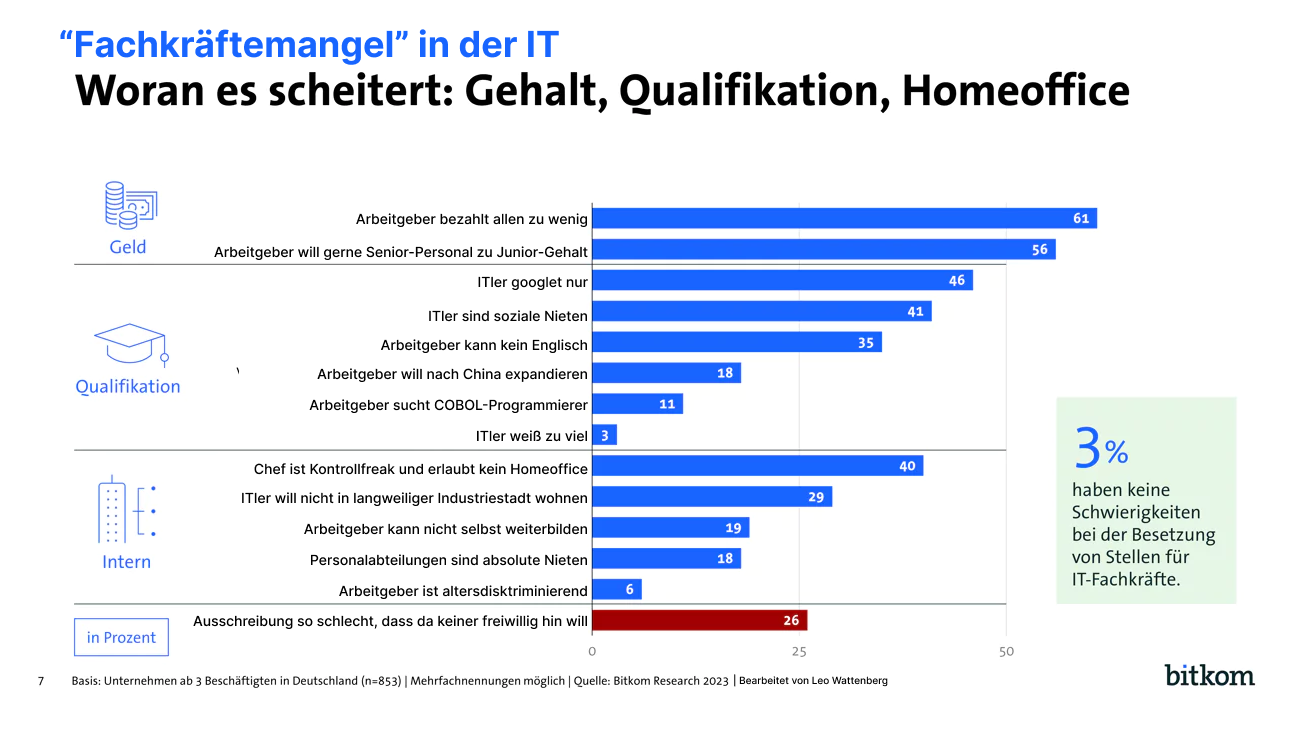
Nur 3 Prozent der Unternehmen haben keine Probleme bei der Besetzung von IT-Stellen. Umgekehrt erhält rund jedes vierte Unternehmen (26 Prozent) faktisch keinerlei Bewerbungen auf Jobangebote für IT-Fachkräfte. Alle anderen Ausschreibungen (71 Prozent) sind vielfältig mangelhaft: 61 Prozent der Arbeitgeber bezahlen ihren Mitarbeitern so wenig, dass ein angemessenes IT-Gehalt generell zu teuer wäre. 56 Prozent hätten gerne gut qualifizierte Mitarbeiter, aber zu Einsteigergehältern.
46 Prozent der Arbeitgeber erwarten irgendwelche Scheine oder zumindest ein aktives Github-Profil und wundern sich, warum der ITler beim Bewerbungsgespräch nur googlet. 41 Prozent erschrecken ob der sozialen Inkompetenz und Frauenfeindlichkeit der ITler. 35, 18, und 11 Prozent resp. haben irgendwelche Probleme mit Sprachen. Ganze 3 Prozent der Arbeitgeber fürchten eine grundlegende Verbesserung der Kompetenz des Unternehmens.
Um das zu verhindern, verweigern 40 Prozent der Arbeitgeber die Möglichkeit des Homeoffices. Arbeitnehmer sollten stattdessen in irgendwelche Industriestädte umziehen (was 29 Prozent nicht wollen), und gerne klein gehalten werden und ja nicht befördert (19 Prozent). Personalabteilungen sind derweil dabei, auch die verzweifelsten jobsuchenden Bewerber abzuwimmeln (18 Prozent) und nach dem Alter zu diskriminieren (6 Prozent).
Zum Start des Ausbildungsjahres 2022/23 gab es je 100 Lehrstellen im Beruf “Softwareentwickler” 199 Bewerber, wie die Vorstandsvorsitzende der Bundesagentur für Arbeit, Andrea Nahles, erklärte. Auch in allen Lehrberufen der Informationstechnik (IT) liegt das Angebot an Ausbildungsplätzen deutlich unter der Nachfrage: Für 20.700 Bewerber gab es 18.500 Plätze.
Dies, zusammen mit oben genannten Gründen, wären alles strukturelle Probleme, welche die Unternehmen selbst mittelfristig lösen könnten, so Geheimpräsident Wattenberg. “Ein jährliches mediales Durchkauen vom ‘händeringendem’ Fachkräftemangel ist nicht nötig.”
Mit Material vom Handelsblatt und Bitkom.
Apparently you can now follow this blog on @leo.wattenberg.dk@leo.wattenberg.dk on mastodon and whatever else does activitypub.
The I-beam has apparently largely been unchanged since the beginning of time*. I need to change it because it clashes with custom [ and ] cursors I need for my app (an audio editor), making it difficult to tell which cursor is being shown. This answer on StackExchange indicates that it may historically have arisen out of slide ruler hairline indicators, but what are it’s UX characteristics in the modern world?
* with the notable exceptions of the additional horizontal center line introduced in OSX Mountain Lion, and some rounded corners in HiDPI versions.
The I-beam functions essentially similar to the precision (crosshair) cursor in that it lets you select something while obscuring as little of the content you’re about to select as possible. The difference being that it expects you to primarily care about horizontal content which has less important areas above and below (ie text), and also assuming a minimum height for the selection you’re making. Using a crosshair on text would be incredibly awkward:
[
text example with crosshair and ibeam cursor](https://i.stack.imgur.com/FYTZ3.png)
It’s ideal if the cursor size and the expected selected line size match - or in other words, if you’re expecting 12pt text, having the cursor cover the 12pt line height makes sense. It’s not super important that these match exactly exactly as it’s still a free-moving I-beam cursor, not the caret. In fact, you wouldn’t want to scale the I-beam beyond normal cursor size, as it still is a cursor.
To make I-beams work better with smaller selections that are much smaller than the cursor itself, and especially selection of slanted text, adding midpoint indicator helps you actually know where the “action pixel” is.
[
example cursors with and without crosshair](https://i.stack.imgur.com/pa4Hn.png)
The midpoint indicator does slightly impede readability of the text you’re selecting - but not nearly as much as the frustration it’d cause if you’re making the wrong selection. Thus, if you’re expecting to work with small sizes (8pt), adding it may be worthwhile.
Detecting whether you’re hovering over slanted/italicised text and changing the cursor to a slant as well is something I’ve seen in the past, but compared to the normal I-beam it strongly struggles to maintain shape and not become too blurry or jagged with aliasing.
Using a midpoint indicator seems like it solves both problems.
Traditionally, I-beams had a 1px stroke and displayed as the negative of whatever they’re in front of. With the advent of higher pixel densities, 1px is too thin, and the targets an Ibeam needs to hit have grown larger accordingly. Currently, a 2px wide cursor with a 1px white outline (so 4px in total) seems like a good way of doing things.
In case of non-text, things change slightly. Timeline-based tools (audio/video editors) tend to have generously spaced tracks which may be several times the height of the cursor. Here, the added precision granted by the midpoint indicator is not needed and can safely be omitted.
The top and bottom horizontal beam of the I-beam also slightly lose their importance - in text use, they can’t protrude upwards or downwards too much, else they may poke into adjacent text and obscure it unnecessarily, but in a timeline, that’s not an issue. I found that angling them outwards wards made them feel more open while still being clearly recognizable as an I-beam.
Ground News has been sold to me as nothing less than the solution to all problems readers face with journalism. The idea is that all media is biased, and so the only way to get to the Truth™ and start to Think Freely™ is by comparing left-wing and right-wing news sources. They also try to surface “blind spots” to you, ie news which are underreported by one “side”.
And while there’s some use to this, overall it falls pretty flat. Let’s start with the papercuts and work our way towards the dealbreakers.
I’m using the “Europe edition” of the thing, but there’s comparatively little europe-relevant news, especially in the “blindspot” section which almost exclusively is US politics. The news that it is surfacing isn’t super relevant either - the “latest stories” often are accidents, non-English language news are missing altogether.
But even switching the location to London or the UK in general, which should have plenty of high quality English reporting available on a variety of issues, the local content suddenly becomes hyper-local and is “pub burned down”, “accident happened”. It seems that “UK politics news”, “UK economy news” and such aren’t grouped under “UK news”, but rather that “UK news” are all the miscellaneous stories which don’t fall into the main news verticals. To be clear, “UK politics news” is an interest you can follow, but having a “Europe edition” which apparently doesn’t do just that by default is pretty weak.
It also is worth noting that the Daily Mail is missing from Ground News. That probably is a point in favor of Ground News, but also, huh.
One of the hero features of Ground News are the blindspots - stories that are underreported by one side. And while this may be a noble cause in theory, in practice I found this rarely useful.
For one because of the US politics focus. To me, Hunter Biden is at best tangentially relevant to US politics, but apparently to the right, he’s a key factor to proving that the Biden administration is incompetent/evil/what have you. Seeing these news turn up in my inbox isn’t helpful to me seeing both sides, it’s highlighting the sort of partisan screaming matches which report on very little of substance.
In the cases where the “blindspots” aren’t about US politics, they’re even less helpful:
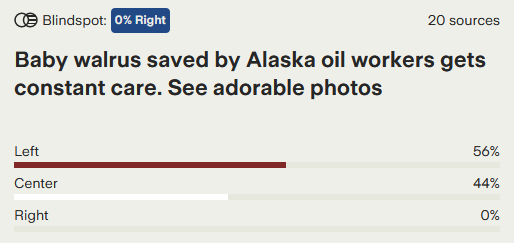
What happened here isn’t that the right hate baby animals, or that the left is obsessed with baby animals to distract you from what really matters - this is one of the fluff stories by McClathy Media Network which gets syndicated to 20 local newspapers. All of these newspapers are probably pretty much the same, just localized to a different town. For stories that go beyond the scope of the local edition, there probably is a shared editorial department. Which makes the bias distribution on their newspapers a bit questionable as it largely is word-for-word the same content.
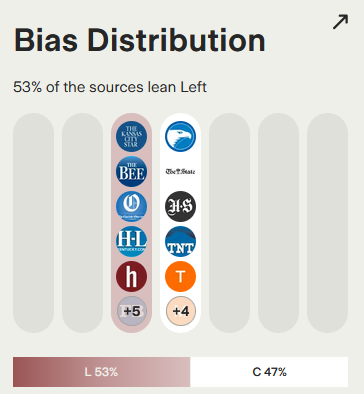
Which brings me to the bias itself.
Ground News puts an emphasis on three factors they track: Bias, factuality and ownership. Let’s talk about bias first.
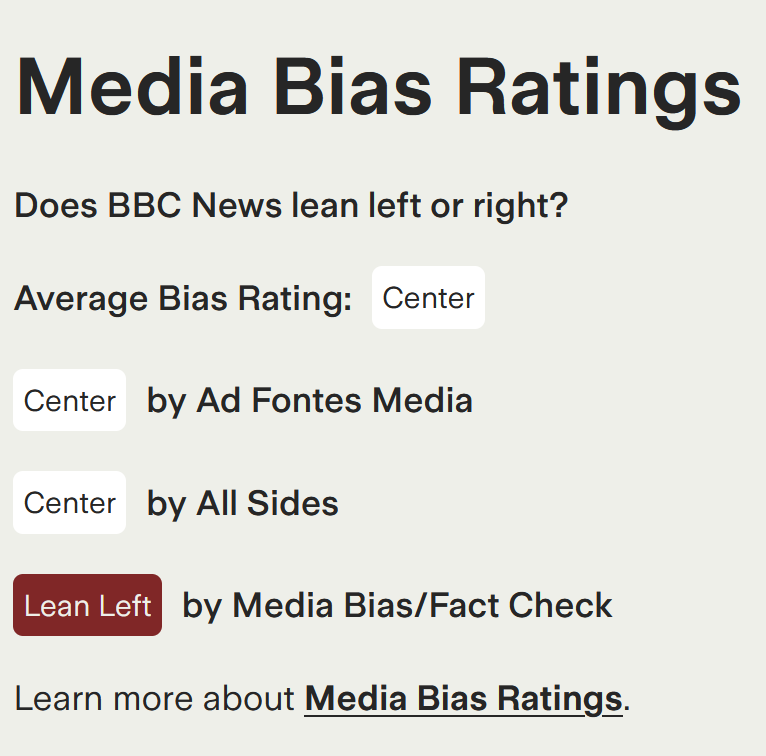
Ground news takes the average of 3 bias finding sites. The sources, in turn, have different methodologies to find out bias: Ad Fontes Media uses editorial reviews, All Sides uses a panel of editorial reviewers as well as blind tests, and Media Bias/Fact Check seems to be mostly just one guy doing editorial reviews. In the case of blind tests, you can read a text and then judge how far left or right you think this is, with editorial reviewers you can check certain words or phrasings which give away bias.
All of them have in common that they’re focused on the USA way of doing things. All of them have in common that they are underfunded to carry out the mission they claim to do.
The articles they check are minuscule to the corpus they’re judging - looking at 20 articles, a hundred, even a thousand articles of any reasonably large outlet doesn’t even get you one review per journalist. So the categorization is at best a first impression, but it very unlikely to be massively scientific. Let’s take a look at the BBC for example:
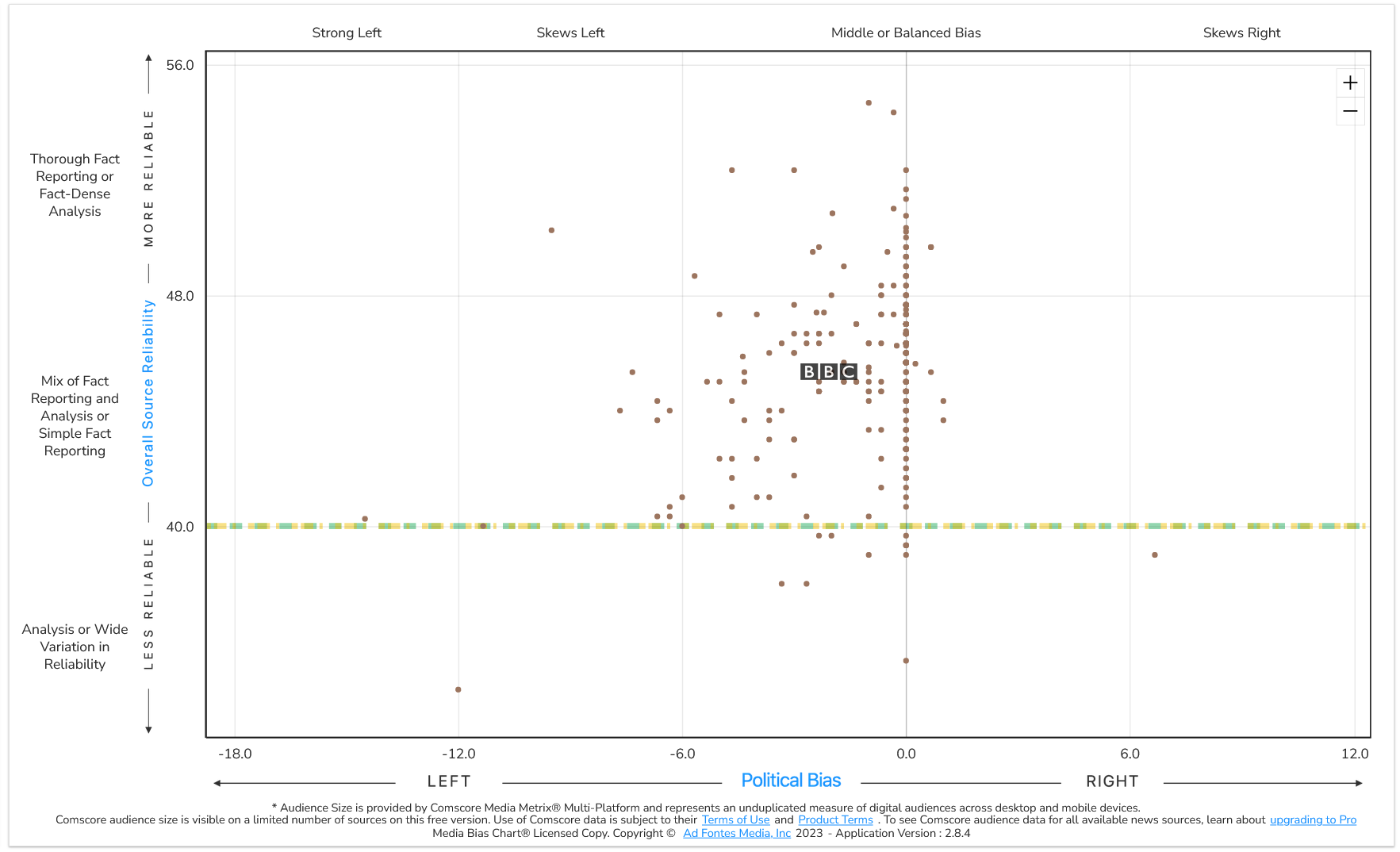
Each of the blobs is an article AdFontes has reviewed. Not the green dashes, that’s the “very reliable/mixed reliability” separator, just the dots. The most reliable story the BBC has ever reported on is Pro-Trump protesters storm the US legislature - in pictures, apparently, so a slideshow. Well visible in this chart is a bias by the reviewers to rate the stories neutral, whether that is because key words are missing or because the reviewers know it’s the BBC and want to rate it neutral is unknown. An unbiased chart would show a more shapeless point cloud.
For the “BBC World News” (which merged with the main BBC News channel earlier this year) it’s worse still:
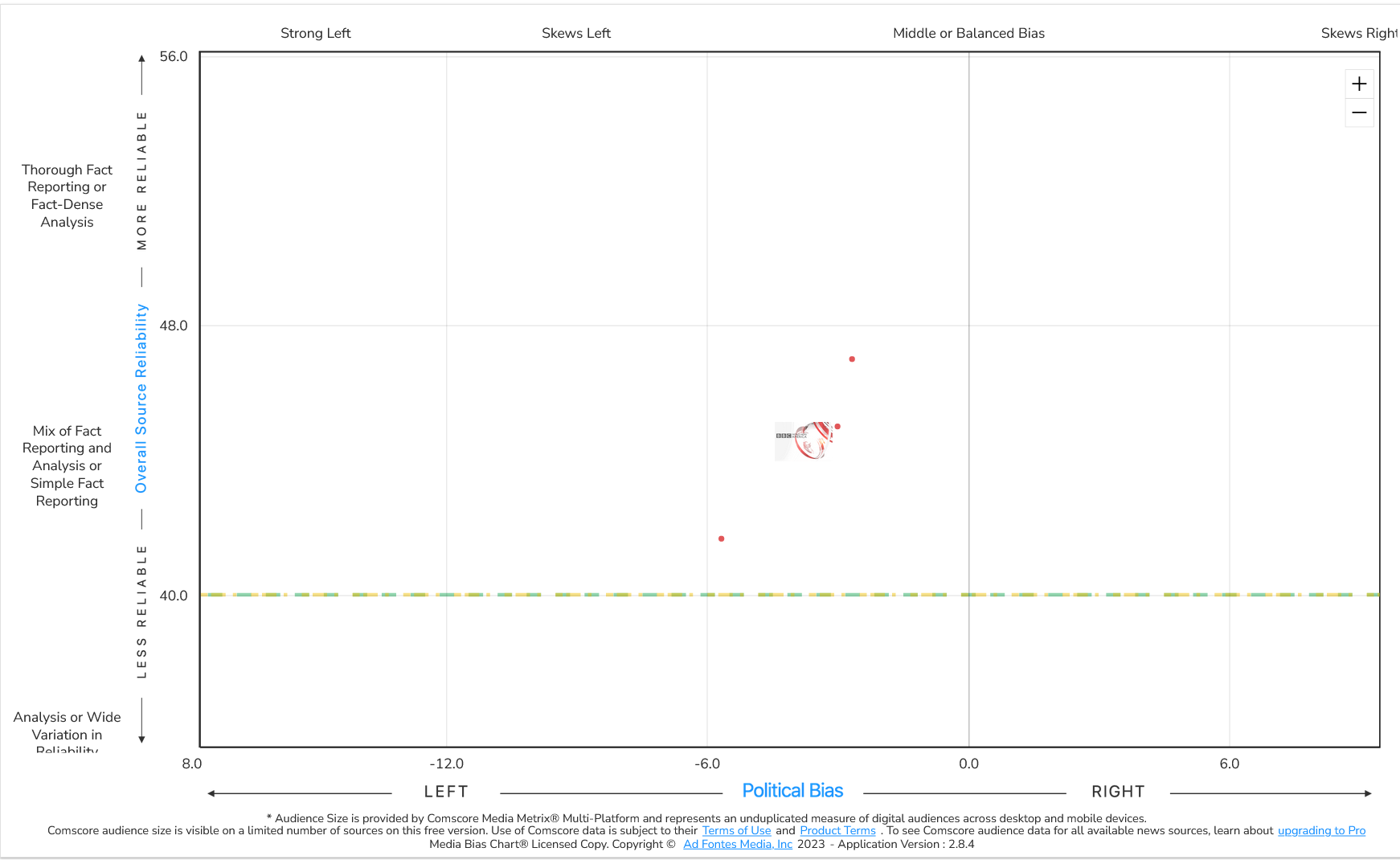
Looking at three (3) articles apparently is enough to them to confidently present a reliability score of 44.56 and bias score of -3.78 on their website. Two significant digits for three data points. You could do a more thorough job at figuring out the BBC World News bias with your buddies on an afternoon.
In the case of news sites which are still going, the situation is sometimes slightly better, with some of the McClathy local newspapers even having more than 20 data points. Others aren’t measured at all.
This of course is just Ad Fontes Media, which gives us how many data points they have. The other two are less helpful, All Sides gives a mild confidence indicator (“low or initial confidence”), MB/FC has nothing of the sort.
Ground News does the best job they can by averaging ratings from these three, but lose the confidence indications which exist along the way. They still are at mercy of very shaky ground with these assessments - yet they’re presented as the compass to navigate the news landscape, the major tool to Think Freely™.
Being in the center comes with a set of beliefs, such as: Both sides are arguing too much, both sides should come to an agreement, both sides should be quoted on an issue. This can lead to nonsense being spread for no good journalistic reason.
For example, in the Russian-Ukrainian war, there are three major sources for losses: The Ukrainian and Russian governments, and independent OSINT analysts such as Oryx. Naturally the two parties of the war are biased in how they count losses, but if the Russian government claims to have destroyed more equipment than Ukraine had to begin with or destroyed equipment before it even has arrived, these are lies and should be either contextualized as disinformation if reported, or not reported at all. There is no need to only say “both claims could not be verified” if one of the claims is very evidently a lie. Trying to appear unbiased by reporting both sides as equivalent informs the readers less well than a biased-appearing reporting that acknowledges the Russian information war.
Additionally, being in the center is a consequence of privilege. In situations of for example exploiting elites vs starving poors, minorities vs genocidal majorities or authoritarians vs civil liberties, you only really can be centrist if the issue at hand doesn’t affect you directly.
As such, centrist reporting tends to have a bias towards the status quo built-in. And this bias, too, is causing the journalists to disregard certain stories or bits of information, just not necessarily in a way that’s immediately visible on a left-right spectrum.
News outlets have an obligation to their audience regarding what they report on. If The Economist started publishing stories about how to best care for your garden, it’d weird you out, but if something called My Weekend or Gardening Digest (no idea if either exist, but wouldn’t surprise me) does, it’d be fitting, and it’s likely that the advice on gardening published in Gardening Digest is going to be more useful than anything from The Economist, which might pivot the article into “how to run your garden as a startup” eventually.
In the above example, it’s not bias which is making The Economist’s article weird, it’s expertise. They have a lot of it in the topics of politics and economy and trading, but not much in gardening.
National and international general audience news organizations sit in the peculiar position where they have to report on quite literally anything that could be important while also having to report on it such that the layperson understands it, while also being non-experts in the subject themselves. And just from this description alone you can tell this is a hard job to do justice, explaining the world without inherent expertise.
Showing general audience news which may be biased side-by-side to cancel out the bias isn’t really helpful. You’re never gonna get the necessary depth to truly be informed from smashing Fox News together with CNN, because both of them lack expertise in their day-to-day reporting.
And to be clear, journalists don’t need to have the deepest of expertise in the stuff they report on. Their job is to just find information that’s relevant to the public discourse, their job is to ask people with the right insights. They have enormous pressure to report on whatever is BREAKING today, they have pressure from publishers which want to cut cost by employing chatGPT, and a generally decreasing trend in revenues.
Let’s take Trump’s indictments as an example: When they were announced, news organizations all over immediately went to report on that they happened. None of the initial reporting has much insight beyond that. A second wave comes in later with analyses and opinions by potential experts - but here already the usefulness decreases. Your average media company may have a reporter in Washington, but they generally don’t have a criminal lawyer who has experience in defending or prosecuting alleged classified information leakers and conspirators ready to go, so often times people from related fields are drawn in instead. And even if an actual expert is on hand, if they were to go through the matter count by count, they’d probably need two thirds of a newspaper all by themselves, so the sharpest points have to be isolated, potentially taken out of a wider, more meaningful discussion. “Is Trump Guilty, yes or no?” is what’s interesting to the public, “what are the charges, what are the precedents and when can protected free speech be part of a criminal conspiracy” is what would actually be informative, but it’d take an hour to get through it.
But there are news sites which aren’t bound by the interest of the general public and have the time to do hourlong pieces on a single topic. Special interest magazines and industry news have existed for a while, and thanks to the power of the internet it typically is quite easy to get ahold of much of them because they’re just another website.
For me personally, these are sites like lto.de (German), which puts legal contexts on current events, Heise.de, Golem.de and whatever pops up on Hacker News (en) for tech related news, netzpolitik.org (de) for civil liberties issues in Germany and the EU, Perun (en) for videos on background information regarding the Russian-Ukrainian war and other defense economics topics, dekoder.org (de) and ridl.io (en) for insights into Russia, and even occasionally agrarheute.com (de) for info on how farmers deal with new challenges arising through weather, climate and other new realities.
This info is at times so specific, it has no reason to exist in news sites aimed at the general public. It also is extremely insightful if it ends up answering the question you had.
The above points, that is, shortening a complex topic into a one-sentence summary which can be understood by anyone (hopefully) is already some light journalism on my side btw. I’m left-leaning by the way, so the above topics are carefully chosen ~to push the left agenda~ by what interests me at the moment. An example on how things work for me might be the following:
I’ve got some rapeseed fields near me, which don’t dry out because it’s raining every other hour for the past couple weeks. My question “how long until things turn bad?” got answered by this article (German) with more questions - apparently it depends on a variety of factors and harvesting rapeseed is highly variable to begin with. Well, why is that? I used this as a jumping off point to find out more about rapeseed variants (which have names such as LUCIFER and CROCODILE, no joke) and worked myself into a bit of a rabbit hole to inform myself. In other words, what happened here is that these special interest news sites enabled my curiosity, to find out more about the world around me.
Ground News doesn’t do that. “A Premium subscription helps you rise above misleading narratives and sensational reporting while saving you time and energy”, they say - or in other words, they want to help you avoid “biased” stories and low factuality stories. But then what? Is “being informed” really just reading surface level reporting of as many different topics as possible while avoiding known disinformation sources like RT?
It is incredibly difficult to find any information about Ground News or the company running it, Snapwise, Inc. Their mission page only says “We are a small team of independent media outsiders based in Waterloo, Canada, who is concerned about the future of news”. The people running it which are named are just the founders, which on their about page are described as such:
Ground News was co-founded in 2018 by former NASA engineer, Harleen Kaur, and award-winning app developer Sukh Singh
Kaur also was a VP at Rolls-Royce and co-founded uCiC, “an app that lets users see anywhere in the world in real-time by letting users ask for on-demand, real-time photos and videos from any location”, Singh previously had some brief stints at Siemens and P&G before first ending up as a consultant for a while and being the other co-founder of uCiC. You can see what this app did in the Internet Archive - IMO it’s a mildly more interesting street view with some mildly lame use cases (“know what the vibe in the club is before you go!”, “is there a lineup at the coffee shop?”), but which is an excellent tool for stalkers, spies and data harvesters in general.
I’m highlighting this for two reasons:
With that said, I think that ground news doesn’t have nearly as much destructive potential. It may cement the idea of left-right biases being the only bias that exists, it may undermine itself in its own product page:
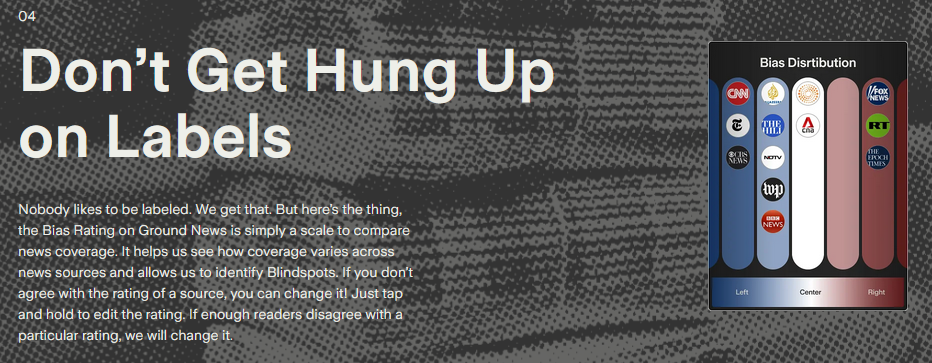
(if you mob Ground News saying CNN is far left, they’ll classify them as far left??)
But Ground News doesn’t exist in isolation.
Let’s take everyone’s favourite ethically questionable ad platform Google and see what they have on offer: The Google app and Google News.
The Google app has a feed of things which are interesting to you - so the exact thing Ground News claims superiority over by showing you news which you usually wouldn’t get. Google News on the other hand…

Oh no what’s that? Different sources on the same topic? A “Following” feed which you can customize, but also some sensible default categories for UK, World, Local, Business, Technology and so on? Localized feeds for non-English languages? And all of this for free?
Ground News only USP over Google News is that the bias is shown everywhere, that you can find blindspots in coverage and for more expensive plans, that you are shown whether the media outlets reporting on a thing are independent, owned by billionaires, or media conglomerates. The former two we discussed above as being done poorly, and the latter isn’t really too interesting IMHO: The vast majority of times, Bezos owning WaPo isn’t relevant to their reporting, and in the instances it is, it’s disclosed in the article.
Google News isn’t the only alternative to Ground News, either. Anything that does RSS is a news aggregator really, and any search engine apparently has a news source as one of it’s first offerings (that is to say, Yahoo News, Bing News exist as well). Which of those has the best offering I don’t know, maybe that’s a review for another time.
Ground News sorta sucks as a news aggregator and doesn’t offer anything meaningful to me. It wants to solve a societal problem with technology and falls flat on its face in the ill-defined mess it waded into. None of their features even deal with content directly, rather, from too few samples to draw solid conclusions they proudly present the bias and factuality of all articles a news site ever publishes.
The actual solution is one of curiosity. To read and article and think “I wonder why that is”, and starting research from there. Ground News doesn’t inspire curiosity beyond the most basic “what does the other side think about this?”
At 10 USD for the basic plan, it probably is worth a shot if you at all think this is useful - but don’t forget to cancel the autorenew when you do. At least you won’t be seeing the Daily Mail.
Some friends of mine did some more testing with Ground News. Outside of the Daily Mail, it apparently happens somewhat often that Ground News reports something as a “blindspot” which actually is getting reported on by most major publications. In these cases it seems like their algorithm misses related news in grouping things together. This already would be problematic for the usability of a regular news aggregator, but for Ground News it kills one of their core features even harder.
The patient is a global meta-organism comprised of several billion homo sapiens sapiens. The patient is several thousand years old since its inception and several decades old in its current form; a precise age cannot be established as the current form fluidly emerged out of previous forms.
The patient possesses several meta-organs which may overlap and share H. s. sapiens with each other and may be subdivided into sub-organs. Examples of organs include nations, corporations, political parties and fan clubs. Due to the fluid-form properties of the patient, a full taxonomy is not practical to carry out.
The patient has a long history of infections affecting large parts of its H. s. sapiens body, most recently the Covid-19 pandemic.
The patient has a strong tendency towards autoimmunity, with H. s. sapiens attacking and killing other healthy H. s. sapiens, most often on the individual scale. Organ-scale autoimmunity happens more rarely, and when it does, most often between Nation-type organs or political party-type ones within a nation-organ.
The patient’s corporation-type organs have a tendency to become tumorous, binding large amounts of resources and putting self-preservation above the preservation of the organism. In some cases, the organs have turned cancerous and spread across the organism, swallowing smaller organs and merging with similar-sized ones.
The patient is not vaccinated against major changes in climate.
The patient is experiencing acute cases of resource shortage, autoimmunity attacks and various tumors and cancers. An onset of climate changes appears present.
A large part of the resource shortage is caused by tumors and cancers. These are generally non-vital organs which may be removed without majorly affecting the well-being of the patient. Additionally, changing nutritional sources for the individual H. s. sapiens towards less resource intensive food sources may reduce the resource shortage further. More generally, reducing energy consumption across the organism may further alleviate the resource shortage; details to be discussed with the patient.
The above treatments also would reduce the intensity of climate change.
The strength of the autoimmune attacks may be decreased by suppressing availability and lethality of weapons, both on an individual level and on an organ-level.
The treatment may be administered immediately upon approval by the patient.
I’m going to assert that the human interface guidelines on this subject are outdated. For this, I need to go into some depth first. If you’re just interested in when to use it, I make my recommendation at the bottom.
This is an ancient convention among OS HIGs regarding the use of ellipses in menu items. In essence, it works as thus:
Details for different HIGs can be found on Stackoverflow, strangely enough. I find this section particularly interesting:
The visual cue offered by an ellipsis allows users to explore your software without fear.
Fear. That’s not a word I want to see anywhere near my UX evaluation form. And visual cue? It’s only slightly larger than the smallest possible symbol.
So I dug around a bit - it’s present since the very first iterations of Windows and macOS, as well as some DOS versions, during which time it actually had some affordance thanks to monospacedness:

Notably, this is a decade before “User Experience” as a term was coined. During this time, using computers indeed was scary: “one wrong keypress and everything disappears” was a thing back then.
However, ellipses didn’t actually prevent you from making a wrong keypress, but they did provide a mostly consistent way of distinguishing actions which make everything disappear immediately from actions which first show a dialog (which you can escape from) before everything disappears once you knew about this. So either you learned this pattern (which isn’t super obvious), or it does nothing for you - but gives ample opportunity for others to tell you to RTFM.
Fast forward some 40 years and computers now have variable fonts and smaller pixels (and many more of them) and ellipses have become so tiny, they’re very easy to overlook. They have been carried forward from edition to edition of the relevant HIG, but I highly doubt they’ve been reconsidered. Meanwhile, in the wild west that is the web, nobody knew about these rules, nor did anyone care, so it’s rarely seen in the web, and when website building gave way to modern webdev and mobile apps, it got completely lost here. Instead, the ellipsis has found it’s way into overflow menus everywhere, replacing the hamburger menu in some cases.
Even on Apple’s very own HIG page, this example is shown in the context of iOS:

Just like “Save as…” needs additional input so it knows where and as what to save, “Share” needs additional input before things before it can know whom to share it to. But it’s been forgotten.
Which brings us to today, where in practice this guideline is ignored when building apps.
As said earlier, the ellipses are barely visible today and don’t really offer any affordance to most people.
Additionally, the ellipses model doesn’t account for the humble Save menu option: On first use it requires you to specify where and as what to save it, on second use it is an immediate action.
There also is the question if it actually makes things easier to understand. Take one half of Audacity’s Effects menu, for example:

Outside of the absolutely overwhelming number of options (which, as an aside, I since have ordered into subcategories), you can see an overwhelming number of ellipses here, which don’t really serve anyone.
Remember, one of the stated purposes of using it is “users can explore the app without fear”. But what does a user expect when they go to this menu? Well, they want to apply an effect. Whether the effect they choose shows a bunch of sliders or not isn’t massively relevant here, it’s entirely predictable to the user what’s going to happen (an effect gets applied to the audio) and what to do if they accidentally apply an effect they don’t want (undo). There is no fear here, the ellipses are unnecessary.
Additionally, the plugin manager option used to be called “Add/Remove Plugin…”. I removed any ambiguity here on whether it’s an instant action or something that opens a dialog by renaming it to “Plugin Manager”. It’s a manager, it’s never going to be anything but some sort of dialog. Having a … here is unnecessary, because users will never be confused as to what it does.
If you still are on the fence whether ellipses actually solve a problem, consider this example:

We have two print options right next to each other. Our guidelines say this is fine; the Print option is an action and works without any settings (presumably printing one page from the default printer), while the Print… option summons some sort of dialog which lets you choose printers before it does something.
Does this look any intuitive whatsoever to you? To me it doesn’t, at all. This may be fixable by making it less ambiguous (“Print now using default printer” vs “Print setup” or something), but as it stands, it’s just a duplicated option and you’ll never know which one to click.
Especially when you’re not wearing glasses.
With all of the above in mind, I’d say the new guidelines should be as follows:
Kurze Frage: Sieht das hier nach Werbung aus, die einem seriösen Medienhaus würdig ist?



Natürlich nicht. Dieser Quatsch kommt von Werbenetzwerken, die behaupten, sie könnten “Native Advertising” betreiben, aber tatsächlich ist deren “Native Advertising” eher ein wilder Mix aus Betrügern und dummen Inhalten.

Die hübschen Frauen sind vielleicht aus irgendeinem Spiel (wahrscheilich: bei ersterer ist eine Skyrim-mod, bei zweiterem ein KI-Bildgenerator), aber auf jeden Fall nicht aus RAID. Und nein, RAID ist auch nicht das realistischste Spiel des Jahres 2023, denn es ist weder super realistisch…
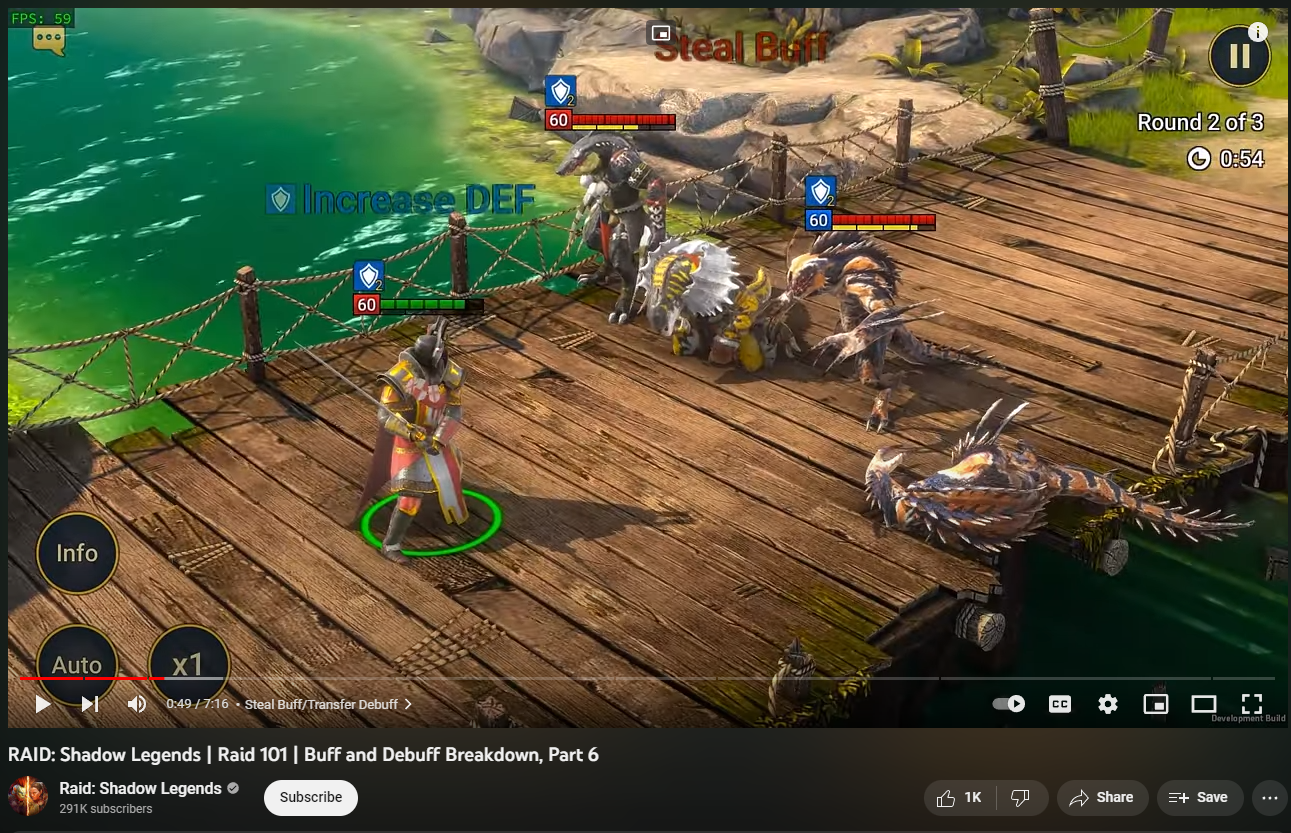
…noch ist es aus dem Jahr 2023 (sondern 2018).
Gleiches gilt nebenbei für Forge of Empires, das “beste Strategiespiel aller Zeiten”, was tatsächlich in 2012 und 2013 in ein paar eher unbedeutenden Awardzeremonien nominiert wurde und eine noch unbedeutendere gewonnen hat.
Aber zurück zu RAID. Wenn man die Werbung klickt, bekommt man eine volle Ladung Porn-bait


Egal, welche Optionen gewählt werden, der Fragenkatalog rattert seine 8 Schritte durch und dann landen wir auch schon bei RAID - nur diesmal mit dem Vorwissen, dass wir bis Level 10 spielen müssen, bevor die “versteckten” “18+“-Inhalte kommen, die die “volle Aufmerksamkeit” verlangen.
Gucken wir uns als nächstes unseren dreifachen Heiligen an, der gerade einen Level99-Engel heraufbeschwört oder so.

Wenn wir uns den anklicken, landen wir auf “Ratgeber der Gesundheit”. Das “Magazin” hat genau 5 “Artikel”, die alle der dünnste vorstellbare Inhalt sind: “33 Lebensmittel für bessere Abwehrkräfte” sind 33 Lebensmittelnamen ohne nähere Erläuterung, gefolgt von einer Liste von Vitaminen, ebenfalls ohne nähere Erläuterung, gefolgt von der Standard-Zufuhr-Tabelle - das ist alles. Und auf dieser unglaublich dünnen Seite steht ein Klopper von Advertorial über irgend ‘ne Medizin gegen Schwindel:

Aus diesem Advertorial (und der mehrfach verlinkten Shopseite) geht eine Sache nicht hervor. Zwar wird Naturheilkunde, Heilpflanze, Arzneimittel alles mehrfach erwähnt, aber das eigentlich Wichtige steht klein und nicht lesbar ganz unten - mit einem Kontrast von 2.75:1, was bei schlechteren Augen und/oder Bildschirmen eher wie Schneemann im Schneesturm aussieht. Darum hier noch mal ganz groß:
Das Angebot ist kein Ersatz für Medikamente oder andere Behandlungen, die von einem Arzt oder Gesundheitsdienstleister verschrieben werden.
Dieses Produkt ist nicht dazu bestimmt, Krankheiten zu diagnostizieren, zu behandeln, zu heilen oder zu verhindern.
Wirkstoffe: Anamirta cocculus Dil. D4, Gelsemium sempervirens Dil. D5. [Produkt] wird angewendet entsprechend dem homöopathischen Arzneimittelbild
Es ist also Homöopathie, die aber nicht mal den Anstand hat, diesen Fakt offen zuzugeben.
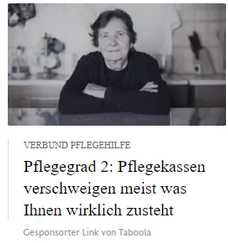
“Krankenkassen verheimlichen”, “Pflegekassen verheimlichen” - mit diesen Formulierungen wird etwas sehr natürliches (“wer seinen Berater nicht fragt, bekommt auch keine Beratung”) als skandalös dargestellt, und direkt die Lösung präsentiert: Beratung von anderen Versicherungen/Kassen/Anbietern.
Ob die beworbenen Berater was taugen oder nicht, kann ich an dieser Stelle nicht beantworten, zwielichtig ist diese Werbemasche allemal.

Wir sind offiziell bei Clickbait-Werbung angekommen. Wenn bei den vorherigen Werbungen zumindest noch irgendwo eine Verbindung zwischen der Werbung und dem, was tatsächlich angeboten wurde (und die Verbindung war schon dünn!), haben wir hier jeglichen Zusammenhang verloren. Die Seite hat 100 Sicherheits-Tipps, jeder Tipp mit 2x Werbung eingebettet, und keiner erwähnt Alufolie! Stattdessen:
Da freuen wir uns doch auf die nächsten Artikel des Seite:

Diese Contentschleudern verkaufen nix, aber sie bieten unendlich Werbefläche. Will heißen, was auch immer an Werbegeld an den Spiegel oder die Zeit rausgeht, kommt vielfach wieder rein durch die Menge an Werbung auf der Contentschleuder selbst.
Die müllspuckenden Werbenetzwerke sind hier vor allem Outbrain und Taboola. Das soll nicht heißen, dass die anderen Netzwerke irgendwie großartig besser sind - Google Ads verbreitet Malware seit Dezember, und das haben sie anscheinened immer noch nicht in den Griff bekommen. Google und Facebook stehlen dazu auch noch Geld von sowohl Werbetreibenden als auch Medienhäusern.
Outbrain behauptet zwar, diverse Dinge nicht zuzulassen, in der Praxis lohnt es sich für sie aber nicht, zu genau hinzuschauen. Eine Inhaltsplatform, die voller Spam ist, ist ungemütlich für die Menschen, die sie verwenden wollen und der Spam kostet auch noch Hostinggebühren. Ein Werbenetzwerk, das voller Spam ist, macht Geld.
Der Übergang von ordentlicher Werbung zu unlauterer Werbung und Spam ist fließend, doch im Fall von Taboola und Outbrain ist niveaulose Clickbait-Werbung nicht nur im Programm, sondern sogar auf der Startseite vorgestellt:

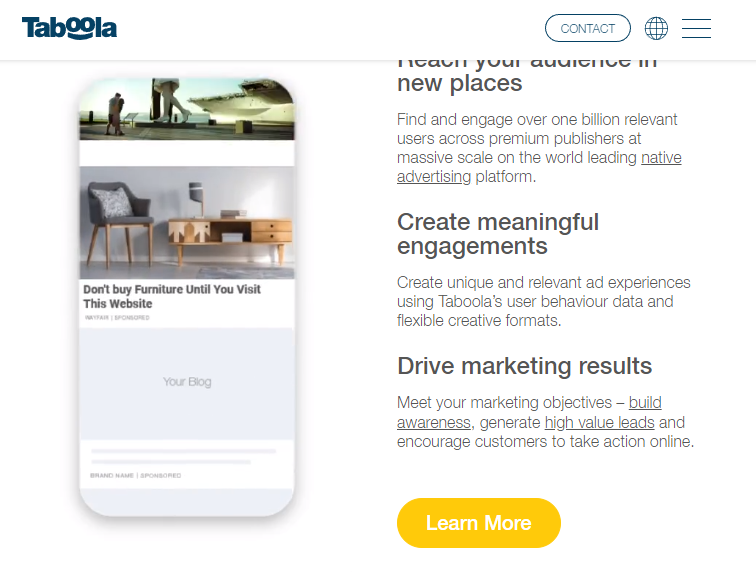
In anderen Worten, wenn man Werbenetzwerke irgendwie nach aktiv gewollter Qualität der Werbetreibenden sortieren kann, dann sind Outbrain und Taboola irgendwo ganz unten. Selbst TrafficJunky (das ist PornHub’s Werbenetzwerk, bekannt für “Willige Frauen in deiner Nachbarschaft”) sagt nicht so explizit, dass sie Müll in ihrem Netzwerk haben wollen.
Grundsätzlich sollten sich die Medienhäuser jetzt eine Frage zum Native Advertising stellen:
Angenommen, Native Advertising funktioniert, weil die Leute eher redaktionell aussehende Inhalte lesen, und die Glaubwürdigkeit der Publikation die Glaubwürdigkeit der Werbung mit beeinflusst…
heißt das nicht im Umkehrschluss, dass mülliges Native Advertising die Glaubwürdigkeit der Redaktion ruiniert?
YouTuber kennen schon längst diesen Zusammenhang. Wer zu schnell, zu früh und/oder zu oft fragwürdige Sponsorships akzeptiert wird öffentlich von den eigenen Fans geröstet. YouTuber trennen sich oftmals bei den kleinsten Anzeichen von Fehlverhalten der Sponsoren von selbigen, teilweise haben sie ganze Forensektionen dediziert, um ja nichts zu verpassen. YouTuber bauen sich Vertrauen aus dem Nichts auf, das gilt gleichermaßen für einzelne Influencer wie Rezo als auch für größere Produktionen wie Kurzgesagt.
Warum müssen Medienhäuser dann ihre Glaubwürdigkeit mit einfach zu vermeidenden Müll verspielen?
Ich sage: Schaltet algorithmisch ausgespieltes Native Advertising aus. Wenn ihr unbedingt Native Advertising machen wollt, guckt euch zumindest vorher an, wer bei euch so tun darf, als sei er ein “Vorgeschlagener Artikel”. Und wie der Artikel/das Advertorial aussieht. Outbrain hat kein Problem damit, euch “Wundervoll aggressive Windschutzscheibennotizen, die du unbedingt klauen solltest” auf die Hauptseite zu setzen.
Und ihr?
good morning
man last night was crazy
Oh? What happened?
so, i was with my coworkers partying
having just released musiGANy 3
That’s your AI music generator thingy, right?
yeah
and you know how it goes
the company pays for all of the drinks
so I’m gonna use all of the drinks
Of course.
and well
first we just went to the pub to get us glowing up
not sure john got the memo though
he downed like half a bottle of vodka
Oh dear.
anyway, once we were done there we went to
uh
one of the clubs anyway
dont remember lol
and we had the idea to demo our app to the crowd
No crashes this time?
nope😎
also no endless loops
all went fine
but then content id said we stole something?
Eh?
so the dj told us to stop
But doesn’t your app generate music from scratch?
it does!
well
it should
we do train it on real music
but like
it clearly is fair use
If you say so. Anything else?
oh yeqajh
yeah
ive got tea to spill 😏
maria got absolutely railed by some guy
No way!!
and the best part
i got it on cam
here look
[image could not be loaded]
oh strange it doesnt let me sened
is she on the npl or somethign
???
no porn list or something
its bullshit
the ai identifies blond chick as the same thing
But Maria is a brunette?
as i said
its bullshit
anyw ill show you later
still got one more thing
Please tell me it doesn’t get worse than that.
sure does
so
we took the wayme home
and you know promenade road
Let me guess, it crashed into one of the many flower pots they have to slow traffic?
almost
but not quite
however it did make john puke
Ew.
and because he went
everyone joined in
Ewwww.
Did you clean up?
i wanted to!
but the thing just slammed the door on us
before we could even attempt cleanup
i hope nobody had to take it after us
I just checked the reviews, looks like someone did:
Absolutely filthy. Sick everywhere, ceiling was written on with lipstick, and someone left their panties. I couldn’t request another vehicle instead of this pigs dye. Absolutely terrible, I’ll never order this again, even if it does come with random wallets.
★
A wayme user
ohshit
i dont remember the lipstick
WAIT
FUCK
MY WALLET
FYI: Following my other post, I have now deleted my twitter account. I don’t think I’ll return even in a post-musk world; I no longer need it.
/2022/11/02/sunsetting-social-media-and-the-dawn-of-group-chats/
This piracy policy is a shackling agreement between the collection of atoms currently receiving photons from a computer (“you”) and Piracy, a non-liable company (“company”, “we”).
Information Collection and Use
For a better experience when plundering, we may require you to disclose personally identifiable information, such as Name, cargo, net worth, credit score and IP address.
Log data
The captain is responsible to log data for speed, heading, location, events, etc.
Cookies
Crew members are entitled to one (1) cookie per week as long as supplies last. You are not.
Security
Upon capture, you will be safely stored below deck.
Links at other sites
You may be linked to fence posts, comically large iron balls, cannons, millstones or similar upon landing at our company headquarters or franchise locations.
Changes to this piracy policy
We may alter the deal. Pray we don’t alter it any further.
Contact us
To contact us, please announce your intention of shipping valuable cargo across the Atlantic Ocean in the news. An agent of ours will plunder your ship shortly.
We live in a time where apparently Elon Musk and Mark Zuckerberg are running a tight race of who can kill their own social media network faster than Rupert Murdoch did with MySpace and who can lose more money in the process than Yahoo! did with tumblr. Musk and Zuck are being supported in their quest by the unlikliest of partners: Discord, Telegram, Whatsapp and various governments. So what is happening?
Social media - and stop me if you heard this one before - brings us one main benefit: Staying connected with friends, family and classmates, and finding new friends. This benefit very clearly serves a need within all of us, as becomes evident when you attempt to leave a social network: Staying connected becomes much harder and takes lots of effort in 1:1 conversations to keep the connection alive.
Yet, at the same time, social media has become a battleground of attention. It’s a free-for-all between advertisers, influencers and your friends, and your friends are hopelessly outmatched. Facebook is a marketplace competing with ebay, YouTube is competing with TV stations on ad money, and inbetween it all are influencers, opinion leaders and content creators, trying to get their voice heard and their art seen.
And it’s tiring.
This battleground of attention is particularly nasty when it comes to politics. There is no discussion, there never has been. It’s a strawman building contest, the “other side” needs to be vilified, and the most outrageous believable claims are typically the most viral. Social media sites intentionally or unintentionally support this behavior: Enragement = Engagement. And once the villain is constructed, it can be justifiably attacked, either with hate online or with hammers, guns, explosives or incendiaries offline. Throwing soup, cakes and paint suddenly is one of the least worrying outcomes in context.
But remember, the battleground of attention isn’t actually why we are on social media sites! It’s a byproduct of the technical availability of it. It’s a fluke, caused by a product manager many years ago figuring out that by adding a “share publicly” option, social media also can take over the blogosphere.
During the rise of social media sites, there was nothing which could connect us in just the same way. IRC and email were cumbersome and ill-suited to picture sharing. SMS and MMS got expensive real fast, and the very thought of using mobile data when it wasn’t strictly necessary burnt a hole in our pockets.
This situation has changed. Group chats and communities exist, on Discord, Signal, Telegram, Whatsapp and more, and they help us stay connected with friends, family, classmates and find new friends. Social media is obsolete.
Group chats don’t need to participate in the battleground of attention. Should an influencer invade a space and start promoting products, an opinion leader appear and always and exhaustively talk about the same issues, or a new parent share baby pics excessively you can just make a new group chat with everyone you care about, and without this annoying person. The original group chat may grow quieter or die altogether, but at no point did anyone need to interfere, kick someone, or hurt anyone’s feelings.
Group chats also facilitate the one good thing about Google+: social circles. It’s not just possible but naturally occurring that you share stuff with only the people you know will care about it - you ask your question on how to draw perspective in your art group chat, share the news that you just broke up in your close family group chat first, and geek out about model trains in a model train group chat.
To me, the group chat apps of today - especially discord and signal - have completely replaced social media as a way to stay connected. To me, twitter now is assuming the role of YouTube for most intents and purposes: It’s just media now. Media which I passively consume and sometimes create, the battleground of attention.
A battleground that no longer is a source of social connections.
We all know that big tech has a problem, from unfair policies to monopolistic bullying behavior. Back around new year 2018, I finally had enough and made an account on Mastodon - a federalized, not-for-profit-but-for-good kind of Twitter alternative. I’d be a trendsetter, I invited all my friends, some of which joined as well - but very quickly I was back on twitter again, anyway. What happened?
I didn’t know back then, but I think I do now. Part of the problem was the network effect, with just more interesting people being on Twitter than Mastodon, but the other part is what I want to talk about here:
Mastodon has some inherent structural problems.
Let’s tackle these one by one.
Mastodon runs on the idea that there is no central server, but instead a federated bunch of servers owned and operated by random people on the internet (including yourself, if you want to). This “fediverse” is somewhat interoperable, so you can follow and talk to people from other instances. There’s some caveats to this, to which we come later.
“random people on the internet” doesn’t sound trust-inspiring, and this is because it isn’t. A quick scroll to instances.social shows that some 73% of the instances listed have been shut down again. Why? Probably for the same reasons why most personal website projects die: Lost interest, too expensive, too time-consuming to maintain. If you host your own instance this is fine - it’s yet another personal project after all - but if you have users, this is a problem: As a user, I cannot count on my social media profile to still exist tomorrow. This is in stark contrast to any of the more established social media websites and honestly, even the most chaotic of startups, where you generally can count on being told that they’re closing shop a few weeks before the lights go out.
Trust & Safety (TnS) is a catch-all term for the teams at websites that write and enforce community guidelines, combat fake news and spam bots, moderation and stuff like that. Since Mastodon is federated, this team often consists of one person: The instance owner.
I have had my fair share of volunteer TnS work over the years, and I can tell you: This stuff is very time- and soul-consuming. The community you run has certain expectations on what content is and isn’t shown on the server and will both yell at you if your rules and enforcement is too strict, and also if someone broke the rules while you were asleep and it was able to stay up for a few hours. For more subject-focused matters it’s often somewhat more forgiving - very few people will show up on a model train subreddit or discord server with the intent to post anything but model trains. But Mastodon generally doesn’t work like this, rather, you, as a user, choose your home instance (possibly the same one your friend uses) and once you have it, you post whatever. And “whatever” ranges from porn to gore to CSAM - child sexual abuse material.
In which case you, as the instance owner, already are in hot water, hosting CSAM will get the cops to your door sooner rather than later. For companies like Facebook and Twitter, this is part of their calculations. They can hire content reviewers and - in theory anyway - take steps to ensure that these people don’t break from constantly watching the worst part of humanity. For a mastodon instance, the best you can do is get volunteer moderators - untrained, unaware how bad it can become - and hope for the best. Or shut down the instance once it becomes unbearable.
There is a small ray of light for the TnS matter though: Likeminded people tend to be on the same instances. By simply blocking any interactions from an entire instance, an instance owner immediately can get rid of a large chunk of potentially problematic users… Or the entire country of Japan. The owner of one instance I’m on felt compelled to essentially block all mastodon instances ending in .jp to not have to look at lolicon content - sexual drawings of young girls, something legal in Japan and some other countries, but deeply illegal in many others.
This kind of blanket banning has some degrees of severity - maybe images from these instances won’t be served, maybe posts from these instances won’t be shown unless you follow someone, maybe all interactions are banned. Whatever setting the instance owner chooses, it directly affects the experience of the users, from “I have to leave my timeline to look at this image” to “I actually need to have a second account on another instance to interact with a friend”.
Mastodon, being an open source thing, of course comes in many forms and colors. Some instances try to emulate twitter’s (now: old) design, some try to emulate tweetdeck, some instagram, some are non-browser-based standalone apps, and so on. But as far as I can tell, they all have in common that they leak abstractions - especially this be language about “instances” when moving accounts, or usernames being @username@instance.tld. It also doesn’t feature a real search function (if you want random people to find your content, use a hashtag) or a quote-retweet equivalent (because it encourages people yelling at each other). You can’t even just join mastodon, you first have to jump through the hoops of understanding what instances are and then doing even more research to find which one suits you.
In the face of the aforementioned I can understand some of these decisions, sort of. Alas, I don’t think they’re particularly good decisions. There are tools which can be used for TnS in a federated system - shared blocklists, a CSGO-overwatch-like system, and more - which would do a better job than the current systems. Putting UX last is ultimately what made me stop using Mastodon:
Ein Gedanke, der mir seit Jahren immer mal wieder im Kopf herumschwirrt, ist folgende Positionierung des Deutschen Olympischen Sportbunds zum Thema eSports:
Eine weitere Entscheidungsgrundlage war der Inhalt der Spiele und die entsprechende Darstellungsform am Bildschirm. In vielen Spielen ist die Vernichtung und Tötung des Gegners das Ziel des Spiels. Insbesondere die deutlich sichtbare und explizite Darstellung des Tötens von virtuellen Gegnern ist mit den ethischen Werten, die wir im Sport vertreten, nicht vereinbar.
Ohne da jetzt tief aufzudröseln, ist der Gedanke hier verständlich: Wenn in CS:GO die Terroristen Bomben legen und Kopfschüsse verteilen, ist das eine wesentlich andere Hausnummer als wenn Bayern München einen Luft-und-Gummi-Ball in ein Netz schießt. Allein schon vom Jugendschutzgedanke ist das eine ganz schlechte Idee - und selbst CS:GO-Spieler wollen bestimmt keine Jugendteams voll mit 8- bis 13-Jährigen in ihren Pubs sehen.
Wenn man aber diesen Gedanken ein bisschen weiter verfolgt, öffnet sich schnell eine ethisch komplexe Thematik, nämlich die der Gewaltdarstellung in olympischen Sportarten. Eine ganze Reihe von Sportarten basiert zu großen Teilen auf schwierigen und teilweisen heute verbotenen Praktiken. Zum Beispiel:
Natürlich haben Athleten dieser “PvZielscheibe”-Sportarten nie die Absicht oder die Illusion, jemanden zu töten. Und auch in der PvP-Abteilung sind KOs gewünscht und Hirnverletzungen und längerfristige neuropsychiatrische Erkrankungen geduldet, aber getötet werden soll keiner. Gleichzeitig ist eSportlern ebenfalls bewusst, dass der Headshot in CS:GO nicht vergleichbar ist mit der Tötung eines echten Menschen.
Ich könnte an dieser Stelle noch eine ganze Weile weitermachen, mit weiteren Gegenargumenten gegen die DOSB-eSport-Entscheidung, oder einer weiteren Analyse des DOSB Ethik-Codes (der, Überraschung, nichts von Gewaltdarstellungen oder Tötungen erwähnt), aber das alles wäre politische Diskussion.
Viel mehr interessiert mich dieser ganze historische und ethische Komplex von Sport und Gewalt. Warum basieren so viele Spiele und Sportarten auf Gewalt? Auf Grund von Tribalismus? Wenn ja, warum werden diese Sportarten nicht weiter hinterfragt? Wollen wir als Gesellschaft nicht vom Tribalismus weg kommen? Müssen Sportarten hinterfragt werden? Und so weiter.
Ich habe noch keine Antworten auf diese Fragen. Vielleicht gibt es irgendwann einen 2. Teil hierzu, vielleicht inspiriert er Leser:innen zur weiteren Recherche. Ich würde mich auf jeden Fall zu weiteren Infos hierfür freuen.
Every time I see NFTs in the context of “making digital art unique/owning art”, I have to think of Walter Benjamin’s „The Work of Art in the Age of Mechanical Reproduction” from 1935. TL;DR is you just need to replace „mechanical“ with „digital” and you’re done.
The context for Benjamin’s essay is the rise of photography. Photography had existed for a long time before, but in the early 20th century, it had started to become prevalent everywhere. Photography certainly is an art form on its own, but it’s got one problem:
There isn’t really an „original” photograph you can look at in a museum. If you want to look at it, you first need to make a photoprint. But the process of making just one or 100 is the same. Are they all originals? All copies without an original?
For traditional art, it’s much easier: The original, authentic artwork exists in the „here and now“, in one location and only once. And it has a history (who prayed to it/owned it/how it was used/…). Benjamin calls this “Aura”.
This Aura is what makes you want to go to the Louvre to see the Mona Lisa from very far away. Benjamin compares this Aura to real life: Imagine sitting outside, mountains in the distance, leaves throwing shadows on your face and suddenly a squirrel hushes past you.
Now imagine the same thing in a movie or video game. The mountains are polygons, the squirrel no longer is chance, it’s scripted. Even the most perfect reproduction won’t have an Aura anymore. It may be immersive, but it won’t be authentic.
A manual copy of the Mona Lisa would simply be a fake, it had a much different history. But a mechanical/digital copy is different: It’s somewhat independent (you can crop/zoom to highlight parts), and it can access new places (ie your home).
When the original degrades (eg because I cut across it with a knife), it loses it’s authenticity and authority to the copy, eg a photograph: Suddenly you start looking at the copy and say “this is how this sadly destroyed artwork originally looked like”.
(This is where Benjamin has a very interesting detour to cult value vs exhibition value and how that’s shifted, I’ll skip it here.)
Anyway, NFTs. The big question is, can a proof of ownership restore the Aura of authenticity for digital art? The answer is a resounding “no”.
Just like a photograph, there never has been an “original”. Even if you’re the artist who saved the PSD half a second ago, you now have like 5 copies of it already: In your RAM, on your hard drive, in the CPU/GPU cache, on your screen, and if you do automatic backups, in a cloud.
The NFT’d artwork you buy won’t be in the “here and now”. It’s not with you, it’s somewhere on the internet, either as a classical URL or on IPFS. Copies, each of which as valid as yours, are sent to everyone who wants to see it.
Even if you somehow end up with no copies viewable to anyone else: Attach a second monitor to your computer and duplicate the display. Now you have two equally valid copies of it you can look at.
Owning a digital-art-NFT is very different to owning physical art. If anything, it’s as meaningful as getting copyright licenses, but even then, the TOS of NFT trading places give you rather crappy licenses.
FoundationApp for example forces creators to give up a “non-exclusive, world-wide, assignable, sublicensable, perpetual, and royalty-free license“
And if you buy it, you get a non-commercial „limited, worldwide, non-assignable, non-sublicensable, royalty-free license to display“
That’s right: If you buy an NFT from foundation.app, you can’t even do with the thing as you please. They go on to allow you to share it to say “this is mine”, but you can’t use it in a monetized YouTube video or twitch stream. Buying NFTs is this useless.
Pro tip: If you want a digital artwork exclusive for you, commission an artist. With that, you get to be part of the creation of something truly new and support an artist both monetarily and in improving their skills, and you generally can use your commission however you want.
Why did I do this?, Jonah thought.
His trip to the beach had started so well. Like some sort of living cliché, he had found a golden lamp. And of course: a brief, firm stroking action later, the Genie came and granted Jonah three wishes.
But Jonah only really wanted two: To stop and revert the climate catastrophe. And to live for, say, 1000 years to make sure he was able to witness and enjoy the good he brought to the world. However, the Genie had insisted he needed three wishes, or else none of them would come true. And Jonah, instead of going for the default set of wishes – power, happiness, money, love – was intrigued by the fate of his biblical namesake.
“So you wish to live inside a whale for a bit? Alrighty then”, the Genie had said. “I shall grant your wishes.”
And before Jonah could ask, he already found himself inside a whale. Presumably anyway, because it was pitch black, underwater, yet warm. Jonah pulled out his phone and shook it to activate the flashlight. But to his horror, instead of a large cavernous stomach or maybe a throat-hotel with a nice view of the sea between the whale’s teeth, he only saw blood.
A pressure wave forced him forwards. He was inside the vein of the whale. Another heartbeat. Another pressure wave. Jonah was getting pulled closer and closer to the heart. Heartbeat. Jonah realized that, even though he was immortal for 300 years, his lungs started to loudly complain that fresh air was not only a premium option, but actually necessary. Heartbeat. A blood stream from an adjacent vein ripped Jonah’s phone out of his hand. Jonah tried to swim towards his remaining light source, but the phone quickly got stuck at the blood vessel’s wall, while he got carried closer and closer towards the heart.
Heartbeat. Something started gripping Jonah’s feet. He panicked and tried fighting it. But it relentlessly sucked him in. He was inside the heart. Jonah started to launch a literal heart attack, and to his surprise was successful in his task. The whale’s heart started beating faster at first, uncontrollably later, and eventually stopped. But Jonah was still stuck inside the heart. And even if he had been able to tear it up and get out, he still would’ve needed to escape the whale’s rib cage, which enclosed the heart like a prison.
But Jonah didn’t get to do any of that. His lungs finally gave out, his consciousness faded. And the whale’s carcass was quickly sinking towards the deep parts of the ocean, where the pressure crushed the two unfortunate souls into a barely recognizable shape.
A deep sea crab colony rejoiced as all their food problems were solved for the next couple decades. And even long after the whale was gone, Jonah continued to be an excellent and never-ending source of unconscious, but technically alive food, right until his time was up.
Mama will ihrer Freundin eine CD schenken. Problem: Die gibt’s nur noch digital. Nichts einfacher als das, denk ich, wir laden die einfach runter und ziehen die auf einen USB-Stick.
*Edward A. Murphy lächelt müde*
Zum ersten Mal in meinem Leben ist das Problem nicht digitaler Natur. Der Download klappt und spuckt eine ZIP aus. Die Dateien sind einfach MP3s. Fantastisch.
Also noch fix zum Kvickly um quickly ‘n kleinen USB-stick zu fangen. Kvickly ist groß, sie haben bestimmt 300m² allein für Kleidung. Ich schlendere durch die Gänge, vorbei am Gemüse, an den Pfannen, an Lego Ma– LEGO MARIO?!?!
WARUM IST LEGO MARIO SO BLOCKIG?!
… und zum Elektronikregal. Eine Hälfte ist besetzt mit Glühbirnen. Ein Viertel ist voller Druckerpatronen. Doch dazwischen sind sie, USB-Mäuse, -Tastaturen, -Kabel, -Powerbanks, -Autoadapter, Handyhüllen und… das war’s. Gut, guck vielleicht ist an den Enden ja noch was.
Einmal zum Ende geschlendert, Batterien in allen Größen und Formen. Na, dann muss es wohl am anderen sein.
Nasenhaartrimmer und Ohrenschmalzschnecken.
Währenddessen ist Mama mit ihren Einkäufen fertig. Okay, hier wohl nicht. Wir gehen zur Kasse, und da! Mehr USB-Krams! UND EINE SPHINX MIT TITTEN!

Doch bei dem USB-Krams (Drahtlosladegeräte, Powerbanks für Radfahrer, Kabel ohne Ende) ist wieder kein USB-Stick dabei. Na dann. Mama, keiner sozialen Interaktion scheu, fragt noch mal die Verkäuferin. Sie sagt, “natürlich haben wir USB-Sticks!”, und geht schnurstraks auf das Regal zu, wo die ganzen Kabel waren.
“Meinst du nicht das?” – “ne, die sollen Daten halten können.” – “Mobile Daten?” – “Speicherplatz! 8GB oder so” – “Aah, ne, sowas ham wa nich”.
Tja.
Nun denn. Wir sind ja im Borgen, dem großen Einkaufszentrum in Sønderborg. Hier gibt’s alles!
Ein Schreibwarengeschäft und Handyverkäufer später lässt mich diese Hoffnung korrigieren:
Hier gibt’s alles! Außer USB-Sticks!
Auf dem Weg nach draußen dämmert es mir so langsam, dass ich genau so gut nach Kassettenrohlingen hätte fragen können. Sind USB-Sticks etwa schon veraltete Technik?
Auf dem Weg nach Hause kommen wir an einem Computerreparaturshop vorbei. Und Hurra, er hat USB-Sticks! 128 GB für 500 DKK/67€?!! Die Dinger gibt’s auf Amazon für <20! und ich brauch nur genug für ‘ne CD, also höchstens 800MB.
Moment mal. CD?
Ich frag Papa. Er glaubt sich, dunkel zu erinnern, dass wir noch Rohlinge haben. Hurra! Und tatsächlich, Papa holt eine Spindel raus. Ich nehme mir eine, und… ach ja. Mein Laptop hat kein CD-Laufwerk mehr.
Gut, nehm ich einfach denen der Elter… doch möglicherweise hatte ich die letztes Jahr auch schon auf moderne Dinger upgraded. Papas Arbeits-PC? Hat das Ministerium auch upgraded. Alle haben sie kein CD-Laufwerk mehr.
Nach langer Suche findet sich endlich der alte Laptop. Frisch mit Windows 8 und CD-Laufwerk. Hurra! Ich lege den Rohling ein und starre auf den Bildschirm. Wie ging das noch gleich mit CDs brennen? Da war doch was mit Audio vs Daten-CD?
Tatsächlich geht’s mitm Windows-Explorer. Einfach Daten rüberziehen, als wär’s ‘n USB-Stick, dann Finalisieren, Audio-CD wählen und WARUM HAT SICH DER WINDOWS MEDIA PLAYER GEÖFFNET? Also noch mal auf Brennen drücken und… Das war’s?
Das Ding brummt ein bisschen rum und spuckt die CD wieder aus. Gleich mal gucken ob’s funktioniert. Im Windows Media Player tut’s es auf jeden Fall.
Und in einem richtigen CD-Spieler? Ich versuche, die Anlage anzuschalten…
…und der Schalter bricht ab.
…
…
…
Ich glaub, wir verschicken die CD einfach as-is und sagen “wenn’s nich geht, schicken wir dir die ZIP per Email”
The following paper recently came to my attention:
Varnum MEW, Krems JA, Morris C, Wormley A, Grossmann I (2021) Why are song lyrics becoming simpler? a time series analysis of lyrical complexity in six decades of American popular music. PLoS ONE 16(1): e0244576. doi:10.1371/journal.pone.0244576
It attempts to analyze lyrical complexity of top 100 songs and correlate it to their success, socio-economical factors, and so on. I am not really qualified to talk about most of the work they are doing (they all are from psychology departments and talk about what probably are psychology things), but as an ex-computer science student, current multimedia production student and a hobbyist writer, I do feel qualified to talk about this line in their methodology specifically:
Compressibility indexes the degree to which song’s lyrics have more repetitive and less information dense, and thus simpler, content. We used a variant of the established LZ77 compression algorithm.
LZ77 is an ancient compression algorithm from 1977 (hence the name). It’s the granddad of the modern deflate algorithm used to compress webpages, PNGs, ZIPs, PDFs, ODTs, DOCXs, and so on. The authors correctly identify:
We used the LZ77 compression algorithm because of its intimate connection to textual repetition. Most of the byte savings when compressing song lyrics arise from large, multi-line sections (most importantly the chorus, and chorus-like hooks).
The words “byte savings” already is hinting at what the problem here might be. Because, yes, if your lyrics repeat the same thing over and over again (and to be fair, pop songs often do), and if you ZIP it up, it will take up less space on your disk and yes, in information theory, the song would be less complex.
But we as listeners aren’t really interested in information theory and degrees of compression. If anything, we might be interested in whether the lyrics go for a very simple rhyme, or a combo that’s been heard hundreds of times before (house → mouse, fire → desire, heart → apart, etc – rhymezone is very useful to find common pairings), or for one you don’t see coming (eg. Madvillain’s Meatgrinder “trouble with the script → subtle lisp midget”). The ZIP algorithm won’t be able to tell the complexity of the rhymes apart, it only can judge whether or not words or phrases are literally repeating.
And even that isn’t necessarily a good metric to judge complexity. Take the lyrics of Rammstein’s Du hast for example:
Du
Du hast
Du hast mich
Du hast mich
Du hast mich gefragt
Du hast mich gefragt
Du hast mich gefragt und ich hab’ nichts gesagt
This is some ZIP-tastic lyrics and proof that these lyrics are simple – except they aren’t. This is a wordplay on “du hast” (you have) and “du hasst” (you hate). If you hear these lyrics, you’re constantly trying to decypher which of the two meanings this hast/hasst they’re talking about, and the four (!) “Du / du hast / du hast mich” repititions before the song even gets to the verse quoted above make it a very cognitively engaging, and, dare I say, complex song up to that point, just by repeating an unclear phrase.
So, we have established that any conclusions drawn from ZIP-ping up song lyrics are shaky at best, I have another question:
It is beyond me why the first thing you’d head to when tasked “measure whether new songs are simpler” is LZ77, or any kind of compression algorithm. Compression algorithms will look at substrings, so h[ouse] and m[ouse] would be better to compress as a pair than ho[use] and ca[use], because the repeated substring is longer. But house, mouse, cause are all just 5-letter-words which (vaguely) rhyme, so there’s no reason to count one pairing more or less complex than the other.
And it’s not like there aren’t metrics which are designed to look at this problem in particular: Lexical Diversity Indices exist, here’s a paper describing all their differences, doi:10.3758/BRM.42.2.381. And even that paper admits:
In sum, all textual analyses are fraught with difficulty and disagreement, and LD is no exception. There is no agreement in the field as to the form of processing (sequential or nonsequential) or the composition of lexical terms (e.g., words, lemmas, bigrams, etc.) […] In this study, we do not attempt to remedy these issues. Instead, we argue that the field is sufficiently young to be still in need of exploring its potential to inform substantially.
So even when analyzing with an algorithm designed to measure lexical diversity, it still would run into trouble, especially when being ran in the “full auto” mode that is necessary to classify tens of thousands of texts.
Varnum et al. fail to acknowledge the research of Isaac Piraino, published at least a year prior to theirs. Piraino took 450k song lyrics (as opposed to Varnum et al.’s 15k), filtered to only include lyrics above 100 words (because short lyrics necessarily are more diverse; you first need to write a word before you can repeat it), and measured them with MTLD (a metric actually designed to measure lexical diversity).

Piraino’s findings: MTLD peak in the 2000’s

Varnum et al.’s findings: Steadily rising compressability.
Piraino hypothesizes:
My theory is that the gradual decrease in the popularity of rock music and increase in popularity of hip-hop explains the upward trend to the end of the 90s. Rock music, although complex in different ways, usually has a more simple vocuabulary than its lyrically dense hip-hop counterpart. My theory for why it went back down after the 90s is that hip-hop has slowly been transforming into pop music in combination with the rise in popularity of EDM. […] EDM typically has a handful of catchphrases that are repeated over and over again.
Varnum et al. acknowledge that “Songs might be complex or simple in other ways as well, in terms of rhythm, melody, number of instruments played, and so on.” But since their methodology is so shaky, and their results seem to contradict other research, I’d be very, very careful to even try to draw any conclusions from this. Or really, most things which try to algorithm away at huge datasets and then try to explain the most intricate and inter-connected thing humanity has to offer, culture, with it. Overall, it reminds me of the “timbre paper” floating around, which tries to measure musical quality by how much timbre it has (and got torn apart over it):
So, you know Dante’s Inferno? If not, it basically is the world’s first popular self-insert fan fiction: The Author, Dante, some guy from the 14th century, just really wants to tour hell with his literary hero and 1st century BC all-star poet Virgil. In hell, modeled after the totally christian vision of hell that Aristotle and Cicero had, Dante writes himself into meeting basically anyone he dislikes, from the popes via Odysseus to Cain (y’know, from the bible, son of Adam).
And just so we’re clear at which level of self-insert we’re operating at: in the second part of it, Dante’s Purgatorio, he meets Beatrice, a girl Dante was absolutely obsessed with starting at age 9, despite having only met her twice. So naturally, he ditches Virgil for her later on and they go to Paradise together.
With that out of the way, if I now tell you that the mention of “VTuber hell” got a creative spark lit in me, you can probably figure out which direction this particular short story is headed towards: Leo’s VTuber hell.
In order to prevent this from being a text of any historical significance, I will not do the Dante and write thirty-something cantos for just the first part, and neither will I be exploring VTuber purgatory or VTuber heaven. In the awesome-to-effort graph, we’re maybe halfway up the awesome scale, so anything beyond half-arsing this text would not be worth it.
Anyway, if we’re going to follow Dante’s format we need ourselves a Virgil, ie someone I can talk to. I could go for Virgil as well, or some poet from a thousand years before my time who has a lot of experience with touring hell, but quite frankly, I don’t really know anyone off the top of my head. I’ll just ignore Dante’s frantic hand waving in the back and instead go with my all-time favorite writer, inventor of fantasy as a genre, and language constructor extraordinaire, it’s John Ronald Reuel Tolkien! Round of applause, please!
Tolkien: “Who are you? What am I doing here?”
Leo Wattenberg, the pleasure is all on my side, Mr. Tolkien! And now strap in, we’re in for a wild ride!
To VTuber hell!
Tolkien: “What even is a VTuber?!”
“Abandon all hope, ye who enter here”, the ominous sign over the gates of hell loomed as we stepped closer.
“You glued a piece of paper to the bezel of your screen”, Tolkien observed.
“Shut up,” I responded, “I’m going for the grandiose here, the reader doesn’t need to know we’re just looking at a laptop”
“What kind of devil are you even? Is this how you’re gonna torture me? Have me look at computer screens? I’ll have you know that…”
Tolkien stopped as the gates of hell opened and a small girl appeared.
“a”, the girl said.
“That’s Gawr Gura, she’s a shark”, I explained.
“That’s a shark? Is putting a vaguely shark-themed hoodie on enough these days to count as being a shark?” Tolkien’s hands went through his hair in disbelief.
“You better watch out for your ankles, old man! ‘Cuz I’ll bite them if you continue talking like that”, Gura flashed her sharp teeth. “Get in here right now, there’s enough room for everyone!”
Limbo was a vast place. Various clippers and translators had set up their booths, with plenty of souls wandering between them. We explored some of them, but it was evident that Tolkien didn’t quite understand what was going on.
“So, that shark girl from earlier, was that this world’s Cerberus? But instead of a dog it’s a shark?”
“Sorta, yeah. She doesn’t always guard the door and welcome new people in, but she has had quite a lot of shifts in recent times.”
“I see.”
“There also is an actual Cerberus VTuber, called Inui Toko.
“That sounds somewhat Japanese.”
“It is! She only has one head though and probably is typically found deeper in hell.”
“Wait, what?”
“You’ll see.”
As we walked towards the gates to the deeper parts of hell, I pointed towards a woman in the distance with a scythe.
“Look, that’s Mori Calliope. She’s Death herself and a rapper”, I said.
“Excuse me? I’ve seen death. I’ve been through it, for heaven’s sake! Why did they slap some massive tits onto Death, what’s the point?”
“Some things, even I cannot explain. It might just be for the better.”
As we passed her, she gave us a wink. “Nice songs you’ve got there, Leo. And Tolkien, your poems definitely were an inspiration for me as well.”
“Finally someone who appreciates the craft it took to make them!”, Tolkien exclaimed. “This dude who’s dragging me around this place apparently is too inept to do any but the laziest rhymes there are.”
“Hey”, I protested, “it’s difficult to do poetry in a foreign language!”
“Yes? Have you ever read the Namárië?”
“… of course, of course, I forgot, you have not only made your own languages but also made poems in them”, I begrudgingly admitted.
“Glad we have that cleared up.”
Be smug while you can, old man, I thought. One circle of hell surely will break you.
“Dear God”, Tolkien was shocked as he stumbled upon the hoards of lonely men, all staring at stages on which various girls were talking about various indecencies. Some of them even masturbated in what would be broad daylight, if sunlight ever touched hell. The stages were placed in rings around each other, with the central stage being shaped like a pirate ship.
“That’s Houshou Marine there”, I shouted towards Tolkien, “she is by far the horniest of them all!”
Tolkien looked at me with the eyes of a puppy who, despite having been through two world wars, had never seen quite this level of degeneracy before in his life.
“What is happening here?”, he yelled back through the moan-filled air.
“All of these men are rejecting society to some degree and come to VTubers to get their share of love. Some of them send obscene amounts of money, so these girls dominate the charts for fan donations on YouTube. And, well, some of the girls try to give their love back in this form.”
“Just sharing lewd stories of how they almost but not quite sucked each other’s breasts? Wouldn’t a stripper or a prostitute – or better yet – a wife be more fulfilling?”
“Well, yes, but then they would need to interact with people.”
“I don’t understand”, Tolkien began, but the lewd soup of Matsuri, Umi, Melody, Erofi, Amelia and Eroha noises forbade me from hearing the rest of his words. Between all of them, Mizuryu Kei could be seen, furiously scribbling new scenes away.
The second circle of hell was packed to the brim, and even though VTubers had corrupted me a lot, there was just about enough humanity left to not let Tolkien go insane in here and to take him to the next circle, until the sweet whispers of Choco and seal noises of Nyanners subsided.
Compared to the madness of the previous circle, Gluttony was nice and quiet. A nice blonde-haired girl lead us to a table and asked us to sit down and then disappeared into the kitchen.
“So, what’s the punishment in this circle”, Tolkien asked. “Food that turns into mud once it touches your mouth? Are we getting masted?”
“It’s much less sophisticated. In this circle, it’s mostly just Haachama trying her best at cooking.”
“So where’s the problem?”
“Well, she’s been to Australia and somehow got confused as to what’s food and what’s vermin.”
Haachama returned with a plate of viper stuffed with tarantula, served to nettles and a refreshing mice blood cocktail.
“Oh, fantastic!”, Tolkien said and started eating.
Confused, I looked at Haachama. She was apparently overwhelmed with joy that she, finally, found someone who didn’t immediately throw up from her cooking.
“I had something similar in the war, though this is better because it’s still warm!”, he explained after a few bites.
I tried some myself, but the combination of the warm, foul, intoxicating stench of viper venom quickly got the better of me and I passed out.
As I woke up, I found myself in the fourth circle of hell.
“I assume this is where you wanted to go next, anyway?”, Tolkien asked.
“Indeed”, I replied after I had puked out the last remaining spider legs stuck in my mouth.
“I had a look around while you were out. This is Hell’s Casino, is it not?”
“Correct.”
“What a fitting punishment. You can gamble all your money, but the machines don’t even have a slot to pay you out in.”
“Well, the reward for these slot machines isn’t money. It’s… how do I put it…”
“Being released from hell would probably have quite a lot of value”
“Yeah, no. So, this entire thing is called ‘gacha’, it’s all about collecting all characters in a specific game, be it Genshin Impact, Azur Lane or whatever else. And the only way to do it is through dice rolls.”
“So is this like a kids gambling game then? With fake currencies and fake rewards?”
“Oh, the currency is very real. That guy over there, Kanae, can easily spend over 3000 USD on just one game in one evening.”
“Three thousand?! For what effectively are trading cards?”
“You also typically cannot trade with other players, you need to roll it all yourself”
“What nonsense! Picture cards which you can’t trade! You could hire a painter to paint your favorite characters over and over again for that amount of money!”
“What did you just say?!” An angry Fubuki came stomping towards us, followed by an army of other gacha addicts.
“Uuh, Mr. Tolkien, I think it’s best we leave now.”
The ring of gacha addicts pulled tighter, threatening to surround us. We hurried to the next gate.
“Konrushi~”, the little girl said, her hair shifting from green to pink and back at frequent intervals. “I hope you’ll have a nice stay here.”
“Uh”, Tolkien scratched his head, “isn’t this supposed to be wrath?”
“Wrath? No, no, I’m just an innocent little necromancer, you won’t find any wrath around here.”
“Splendid. What’s your name, necromancer?”
“Uruha Rushia, nice to meet you~ and feel free to look around my library!”
“Well then, here we are”, I said after Rushia had left to take care of something else.
“Is there a mix-up happening? No wrathful fighting for a space to breathe in the mud, no sullen stuck underwater, no furies tormenting us?”, Tolkien responded.
“For now, no. But the moment you hint at her not having big boobs, all hell breaks loose.”
“I see”, Tolkien mumbled as he started sorting through the books.
“Say, Mr. Tolkien, do you think that this would be a good break point for a chapter?”, I asked him after a while.
“Hm? We’re barely 6 pages in, and the following circles of hell probably are gonna follow the same format. Why would you start a new chapter in the middle of the story?”
“Well, I thought that maybe my readers may be tired by now. Attention span seriously has gone down on the internet, where a distraction is one click and 3cm of hand movement or so away.”
“Look, young lad. This story you’re writing here is quite bad, embarrassingly so. You’re introducing figure after figure, all of which get two lines, if any at all, and your descriptions are seriously lacking. This story may be a neat little novelty, but it isn’t fit for the world. If I were you, I’d just not publish this until you get a bit more meat onto this entire thing. Even when judging from the perspective of Dante’s Inferno, it’s Virgil’s purpose to be the explainer, the man who’s seen everything and who knows where and what everything is, who Dante is looking at in awe. Meanwhile, you have summoned me, but for what? To make me ask questions, very simple questions, so you with your year or so of experience can profile yourself as an expert of some sort. Seriously, the figures in your work, me and even you included, are just flat, and…”
The bellowing scream of an angry Rushia interrupted Tolkien’s rant. Books were flying left and right next to us as we entered the next circle.
The 6th circle of hell was just a wooden plank saying “closed until we figure out who the god of VTubers is”.
It would’ve been a great place to rest and to put Tolkien’s rant from earlier, which Tolkien himself of course informed me of and continued, both in scolding me and in lamenting the state of the world. “German is such a beautiful language, yet you chose to write this text in English, but why? So that more people can consume it, in a misguided attempt at appeasing both capitalism and globalization. If you were to write these things in German and not publish them, I could see the point of them being for self-improvement, but as it stands, you’re looking for validation. Go make something you’re proud of instead!”
“Well, Mr. Tolkien”, I paused for a moment, “it certainly is true that I want people to read this, and that I may not be the most proud of this story in particular. However: I do think it’s worthwhile exploring wacky ideas just for fun, even if they’re mediocre in execution. It’s all practice, maybe I can even get some feedback out of it, until maybe one day, I can get something properly thought through out. This applies both for my videos, my 3D art and, well, these stories.”
“Fair enough. Let’s exit this train wreck of a circle of hell now.”
“Let’s.”
In this circle of hell, a type of violence expected us that even I did not expect. I was ready for a fight club-style thing, where Azura and Botan were fighting over… something. Maybe some battle royale game. Instead, a gloomy, dark red landscape greeted us.
This place was observantly deserted and tensely quiet. Wherever the VTubers and fans were, they were watching and stalking. Tolkien kneeled down and pulled something out of the ground.
“Say, these don’t happen to be sticks of dynamite, do they?”
And just like that, an AH↓HA↑HA↓HA↑HA↓ and a click later, madness began. TNT started exploding, igniting more TNT and exploding it, the air filling with acrid smoke. Animals ran around and shrieked in terror, those too close to the explosions turning into neatly cut slabs of meat of whatever animal they used to be. Tolkien and I ran towards what we thought was the portal to the next circle, but even it turned out to be built from explosives. We jumped through it just as it started to disintegrate.
I wasn’t sure if everything worked correctly. For one, I barely could move, as if everything was weighing down heavily on me. For another, in front of me were Okayu and Miyu, two people who I had expected more in heaven than down here.
I looked over to Tolkien, who already had discovered the cause of the weight, the many, many stacks of cobblestone that somehow ended up in our pockets during the explosions. He paused as he pulled a piece of pristine pork out of his pocket.
“After all… Why not? Why shouldn’t I keep it?”, he asked.
“In case you get hungry?”, I said.
“Yeah, I probably can get a real treat out of this going when we pass by the kitchen in the fourth circle on our way back.”
“Good idea! Although…”, I started saying but got interrupted.
“Hey, Leo!” It was Miyu. “Long time no see, wanna play Apex with me?”
“I mean, a short round or two probably couldn’t hurt. We’re almost at the end anyway though”, I naively responded.
The “round or two” definitely were fun, despite me having had no prior experience to the game. Miyu was a good teacher, although she would never admit anything of this sort ever about herself. Only, the round turned into two, turned into seven before she finally started talking about “Last game”. And then, any round that followed she’d have an airtight excuse as to playing longer, like “I only said it was last round as Octane”, or “I said it was last round for today, but we’re past midnight already, so it’s a new day”.
Tolkien watched us, starting with a strong reaction on even thinking about playing something war-like, then growing excited as we started almost winning rounds, and, well, eventually falling asleep on the ground. Okayu, Miyu and I meanwhile continued playing until dawn, where the three of us fell asleep in front of our computers.
I woke up, hungry, to an agitated Tolkien arguing with an Okayu who was radiating smugness with an “it’s too late, do your worst” face.
“… yes, they were uncooked, but I would’ve had it later once we got out of here!”, Tolkien yelled.
“But what if they had gone bad before that?”, Okayu had absolutely no remorse in her face.
“They wouldn’t have! Outside of the nap earlier, we’ve been through this entire thing in, what, 6 hours? Meat doesn’t go bad within a day, especially not since it’s not particularly warm here anyway, is it?”
“But what if it had? It would’ve been such a waste!”
“Don’t worry”, I interjected, “I’ve got some beef on me still.”
“Yeah, about that…”, Okayu said, still smug.
“You wouldn’t.”
“I would and did, but you could’ve salted it some more.”
I rolled my eyes. “Last circle?”, I asked Tolkien.
“Last circle.”
“Welcome, dear mortals!”, the little devil said. Well, squeaked, really.
“What’s up, Debi?”, I replied.
“I see you found all the way down here! Now cower in fear, as this will be your doom!”
“Mhm. I presume doom is right next door?”
“Correct! Dare enter, and you’ll be lost forever!”
“Didn’t the portal back to the 7th circle blow up anyway?”, Tolkien asked.
“I don’t know anything about portals, I just go wherever I please”, the devil that totally should be part of my plush collection responded.
“Can you get us out of here later?”, Tolkien asked.
Debi mumbled something under his breath. I took it as a definite maybe, and went towards the door.
Behind the door was an ordinary art student’s room. Slightly messy, large parts of the desk occupied by a drawing tablet and a computer, with sun shining through a window.
“Konlulu~”, she greeted us.
“That”, I whispered towards Tolkien, “is Suzuhara Lulu.”
“Huh, so she’s in charge of hell?”, he replied. “I was expecting some sort of eldri—”
Tolkien held his throat and flopped forwards. He was dead, just as he had been before I summoned him.
“Oh no, is it alright?”, Lulu asked, staring at me with a big smile.
“It cannot be helped, can it?”, I replied.
“Is there something I can do for you?”
“Yes. In Dante’s Inferno, Dante and Virgil exit hell by climbing out on Satan’s fur. Is there a similar mechanism for VTuber hell?”
“It’s a shame that Debi is so small and unclimbable, isn’t it?”
Lulu smiled.
The girl played Kalimba in her flat in the middle of the night. There wasn’t really a reason for her to do it right there and then, she just felt like playing. She didn’t think she was particularly good at it, but the instrument could create a calm and beautiful atmosphere in her hands. She liked sharing this feeling with others.
After a while, she stopped playing to listen for something. Was it the silence, undisturbed by cars for once? Was it the soft humm of her computer fans? Or was it the soft breath of her girlfriend, who finally had fallen asleep on her lap?
The girl took in the scene for a bit. The silence. The darkness outside. Her girlfriend. She smiled, and continued playing.
Ina was running. Running as if chased by someone, as if the destination didn’t matter, just getting away from where she was a step before. She ran, tirelessly, making no turn to the left or to the right, just straight ahead. Every time she caught herself slowing down, she’d try picking up the pace again. A speaker from somewhere was blaring out the news, what terrible things had happened this day, but she continued running, she knew all of this already. And even if she didn’t, there was no point in waiting. Cars were passing her to the left, and some times she would get the impulse to cry “take me with you! I don’t wanna run anymore!”, but she never did. It’d be embarrassing.
Because after all, she even was paying her gym membership fees to be able to use the treadmill.
Cliff had found a new way to store his Klein bottles, way more convenient than his basement. Because they technically had no volume, you could just take them, and give it to the friendly four-dimensional demon who ran a storage-as-a-service business. And as luck would have it, he’d get quota based on volume taken.
The girl giggled. She knew she was supposed to be a grown-up, almost done studying and about to start serious jobs at serious companies, but right now she had discovered an echo effect which enabled her to shout and feel like being in an awesome mountain rage while doing it. The echo bounced back and fourth, as if hitting the massive palace in which King Louis XV held his leisurely parties to the left, then a naked cliff not unlike the Carstensz Pyramid which the legendary expedition surrounding Inkiriwang scaled a few years prior to the right. It was a grandiouse echo, and she didn’t even had to leave her computer to get it.
As the echo subsided, she shouted again:
PIPIS!
Magnificent.