
Hashtag

#2

2 posts tagged with this hashtag.

@leo@wattenberg.dk

City Villages: Desirable public housing for a greener future

We are currently facing several issues:

  1. A housing crisis – housing in places which are desirable (ie: cities) is very short, and not much appears to be done to actually alleviate it.
  2. A loneliness crisis – people have a harder and harder time connecting to others.
  3. A climate crisis – resources are wasted on things like transportation (think long traffic jams in cars), with no real benefit for anyone.

I believe that we can perhaps not fully resolve, but help all three issues with an idea I call “City Villages”.

What is a City Village?

A City Village is a concept to combine the benefits of a city (everything is nearby) with the benefits of a village (you have a much easier time connecting with your neighbors).

In practice, this means some of the following features:

  1. A City Village is designed with walkability, bikeability and public transportation in mind. Cars, as a rule, are banned. Exceptions may be made for people who really, really need cars on a daily basis (and not merely to commute to work).
  2. A City Village is designed with communities in mind. This means that each City Village would feature so-called “third spaces” (spaces which are not home or work; playgrounds, parks, pubs, etc.) not just close to it, but within it. These third spaces facilitate the creation and maintenance of neighborly relations; they’re places you’d want to hang out in, and so would your neighbors. Having a green third space of some kind – and if it’s just a few benches under a tree – is likely something which should happen.
  3. A City Village is designed with privacy in mind. Within each dwelling, it should be possible to be unaware of each other’s existence for all intents and purposes. Good sound insulation would be core here.
  4. A City Village is designed democratically. The tenants living within get to decide what their little patch looks like in practice. This may include decisions like to increase rent to add certain facilities.
  5. A City Village is designed with shared facilities in mind. Not every apartment needs its own laundry machine, or massive kitchen with cooking island. A shared laundry machine and cafeteria with the option for a private small kitchen might be preferable.
  6. A City Village is designed sustainably and affordably. This is not the place to turn into a prestige project to attract billionaires. It’s a place for people to live and thrive.
  7. A City Village is part of the municipality. That is to say, it’s public housing, rented out to tenants by the city. While the City Village can take care of most of its day-to-day needs democratically, it is subject to supervision by the municipality.

Comparison to existing concepts

While I don’t know if anyone has actively gone around to design city villages as I described above, there are some related concepts which are employed at scale.

College dorms

A college dorm acts like a City Village – Extra Cheap edition. Inside dorms, privacy and facilities are reduced to a minimum, meaning shared bedrooms, bathrooms and dining rooms (cafeterias). College dorms offer an excellent environment for forming new friendships: It’s typically impossible to live there without at least living with one more person in the room. It’s typically impossible to eat alone; you’ll generally always sit together with strangers around the table – strangers which eventually turn into friends.

Gated communities

A gated community acts like a City Village – Luxury edition. Gated communities are typically the place to be; they keep the poors out, they offer privacy and protection and usually third spaces en masse. If you live inside a gated community, there often are very few reasons to venture outside it.

Problems with dorms and gated communities

Dorms tend to be loud, lack privacy and tend to provide too few facilities. Sharing a room or a toilet is more efficient, sure, but it probably is one of the strongest reason for people to want to get their own flat eventually. In practice, a Minimum Viable Apartment needs to be defined, and I reckon it would include a private toilet, (micro)kitchen, a private bedroom and a TV-watching-room at least.

Gated communities meanwhile are needlessly classist, racist and overbudgeted. There is no need to class-separate within the neighborhood; all that’s needed is a reasonable neighborhood community to be created. Gated communities also are very much luxury and both unaffordable and unsustainable.

City Village example : The village block

A typical arrangement in many cities is the block, 4 sides of houses; often low-risers (say, 5 stories tall) with an inner court. At the moment, the inner court is often practically unusable as its filled with cars.

Using the City Villages concept, we could end up with the following situation:

  • As cars are banned, the inner court becomes a place to be used by people again. This notably includes a small soccer field for the kids, a few benches, and a tree. For various festivities, kids theater plays, stand-up comedy nights etc, the court also has a small stage.
  • In the basement are a couple laundry machines, drying racks and perhaps tumble driers. There also is a medium-sized workshop, supervised by the custodian, where people can repair some of their stuff and dads can build new chairs or whatever. Secure bike (and general) storage space is also available in other sections of the basement.
  • The ground floor contains various (outwards-facing) shops and commercial things, and also an inwards-facing cafeteria connected to one, where tenants can get a decent, healthy and cheap meal and a chat to their neighbors 3-4x a day. As a lot of the tenants are allowed to work from home, they have also elected to convert one of the commercial spaces into a co-working space which tenants get to use for free, while external people may use it for a fee.
  • On the higher floors are the actual apartments. As this apartment complex only has an ancient goods elevator, the apartments are designed such that the elderly, disabled and families are located towards the bottom, while university students, young couples and other people are placed towards the top. At the very top, under the roof, are the smallest and cheapest apartments, and if it weren’t for the fact that each apartment had its own toilet, you could’ve been mistaken in calling it a dorm.
  • Windows and walls to the outside are well insulated (both for heat and for sound), as are floors/ceilings.

Doesn’t this sound kinda nice?

City Village example : A New House

Another, also unfortunately typical example of a city house is just a random couple single family home surrounded by a bit of garden, with a garage of course. We can be more efficient than that.

  • Replace the old family house with another low-riser, trying to maximize the space. 5 stories might not be doable this time, but 3 probably should.
  • In the ground floor, we build the common room and big kitchen; a place for everyone to hang out. There might be enough room for another apartment, so it’s up to the community to decide whether it’s going to be one, or whether it’d be better suited as a co-working space.
  • In the floor above, we might get 2 apartments in with a micro-kitchen
  • In the top floor, we might squeeze 3 apartments in, though not with any kitchen.
  • On the roof, we can have a nice rooftop party area (and perhaps a place for table tennis? The community decides!)

This configuration would be decidedly more dorm-like than Example , but we do keep all of the core ideas intact. And this, too, sounds like an interesting place to live to me.

Anticipated counter arguments (and their counters)

Now, I’m neither an architect, housing expert nor a public policy planner, so if you’ve read the above thinking “yeah, but that sounds utopic and not practical”, then, sure! I’m open to hearing improvements on this subject. That said, I did think of some things myself:

  • Claim: This runs into the sort of “school board governance” issue where a few people get to decide the outcome of the many.
    • Counter: I’d argue it’s better than the status quo for two reasons: 1. it’s easy to not care about what school exactly does as you’re not directly affected; only your kid is. So I expect higher participation here, given that it’s decisions like “are we gonna have coffee or tea for breakfast”. And 2. the status quo typically has a for-profit landlord as the ultimate decision maker. Any improvement in the democratic process here is desirable, and it should be noted that the democratic process doesn’t happen in a vaccum either – the municipality, state, and ultimately, nation would be able to set certain guidelines within the City Village board can act.
  • Claim: If the community decides to hate a person, they have virtually no recourse in the system you’ve set up.
    • Counter: If your entire neighborhood hates you, then yes, that’s gonna suck, regardless of whether you ownership system. The slight saving grace here is that, with privacy being one of the core ideas of the City Village, you’d still be safe in your own apartment and would only need to interface occasionally with the others in the stairwell.
  • Claim: Wouldn’t the democratic nature of the community setting its own rent result potentially in below-sustainable rent? Or people being priced out of being to live there if a bunch of nonsense stuff is added?
    • Counter: The municipality may set limits on both of those issues. If the house falls into disrepair, the municipality may force a higher rent to pay for the repairs. And if rich people decide to build their own little gated community with private helicopters and whatnot… then the question is why the hell they’re living in public housing to begin with, so a maximum budget for a City Village may also be a thing the municipality enforces.
  • Claim: This actually has the same bad side-effect that gated communities do, in that it increases the segregation of society.
    • Counter: I’m not so sure about that one. In my eyes, offering flats designed for families (3+ rooms), elderly people (2 rooms, but more accessibility features) and students (1 room, tiny) in the same building is going to lead to a reasonably diverse community. Of course, what services each City Village opts into is going to inform potential applicants, so it’s not 100% ideal. I still see it as a major step forward from the largely anonymous and profit driven system which provides exactly 0% consideration to this idea (outside of “no poors allowed”).

Conclusion

City Villages would help us defeat the loneliness epidemic by creating spaces to meet in, City Villages would help us solve the climate crisis by reducing duplication and waste, and City Villages would help defeat the housing crisis. They bring an immediate level of democracy and community into our lives which has gone missing, especially in the cities, and they are designed for people instead of investors.

Sounds nice, really.
Original article

@leo@wattenberg.dk

Kagi: A Google alternative that just kinda.. is?

After seeing the raving reviews about Kagi by esteemed authors Doctorow and Koebler, I decided to use the search engine myself. Compared to my reviews of other services (especially: Ground News), this one is somewhat more difficult to grasp for me.

But just to get started, here’s some thoughts:

  • Using kagi becomes very transparent very quickly. I ~google~ search the internet extremely frequently, and have been burning through their trial period (100 searches) in about 2 days, causing me to get the unlimited plan for 10 USD a month. From then on out and with it set as default search engine, I hardly notice I’m using it vs Google.
  • Kagi is somewhat buggy and out of date. I searched for something Audacity related and filtered results for the past month, and was given a blogpost from many years ago - which I had deleted in october 2023! And a second one from the wiki which I deleted earlier than that even. I understand that my use case is a bit niche, but long-dead pages being indexed is a pretty big pain as it dilutes the actual results. I assume these to be simply bugs which are likely to get repaired reasonably soon - a less charitable reading would simply call
  • Kagi is better at finding results… - One of the toughest tasks I give to search engines is to put in potential groups for the the NYT Connections game. This time it was CARAMEL PEANUTS POPCORN PRIZE, which were the last group remaining but I couldn’t make rhyme or reason of what the connection between them was. Had I searched in DuckDuckGo, I’d only have found the answer keys (which I’m not interested in), had I searched with Google, I’d have almost exclusively found eCommerce links (first place being an amazon link for the actual solution, Cracker Jacks, but everything else being something else as it thinks of “PRIZE” as “PRICE”), but because I searched with Kagi, I did get an info panel about Cracker Jacks with a link to Wikipedia. Very nice!
  • … but it’s usually close… - subjectively, Kagi’s results feel pretty much on par with Google. I do still find SEO spam from time to time. In the cases where I bother checking both Kagi and Google, usually the results are pretty similar (for example Kagi will put MDN on and Stackoverflow on , while Google will have it the other way round).
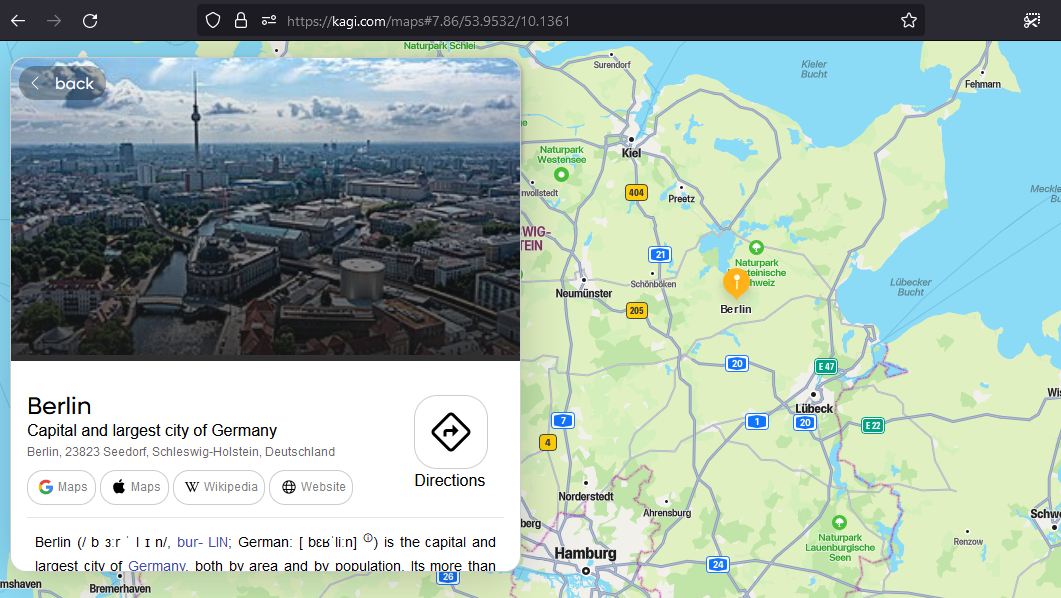
  • … unless it’s about places. Searching for “Alsen”, the German name of a Danish island with 50k inhabitants, the results are good, but the second you go to the maps screen, Apple Maps takes over and plops you into the village of Alsen, part of the Osterstedt municipality which as a whole has 700 inhabitants. Searching for “Als”, it’s Danish/English name instead and going for the maps tab, the results are hilariously broad, with “Denkmal für die im Nation**als**ozialismus verfolgten Homosexuellen” making the cut. The opposite is also true, if you search for Berlin, Seedorf (a small village in Schleswig-Holstein), the map brings you to the place but brings up information about the Berlin you think it is:

Image

Image

A previously unknown capital and largest city in Germany has been discovered near Seedorf, between Tavenhost, Schlamersdorf and Wöbs.

I am unsure who to blame for this state of affairs, whether it’s Kagi or Apple Maps. If it’s Apple Maps fault, I’d highly advocate switching to OpenStreetMap. They don’t run into either of the above cases, and and their map layers also are much more useful (for me anyway - bike is my main transport method, which the Apple Maps embed doesn’t seem to have a layer for).

It’s worth pointing out here that Google lost the ability to show Google maps links for places in the EU due to the DMA1, so in order to compete here, they’d need to start ranking maps providers instead of having a tab.

  • Kagi’s filters (Lenses) are alright. I always found it weird that Google segregates its search engine into Google Scholar, Google Patents, and also hides very useful filters behind completely invisible operators and forms (do you know how to get to the Google Advanced Search page?). Kagi gives them a lot more affordance while keeping the page simple - good!

But with all that said, I have a really hard time deciding whether or not I like it. Which is a problem for something that’s supposed to be a review. Everything’s just luke-warm and alright, I suppose.

But something’s weird…

Kagi overall has a strange feel to it which at first was difficult to put a finger on. Take the following items:

  • In addition to a search engine, Kagi also makes a browser called Orion that exclusively runs on macOS and iOS. Why?
  • Kagi uses pretty grating language in their marketing materials, radiating smugness and snark against their competitors just before or after praising them. Why? On one page they pull up Bard to show “hey, even Google’s own bot thinks that we’re right!”
  • Kagi pretty strongly pushes privacy, and harps on about not having any telemetry. But compared to privacy-first options like mullvad VPN and duckduckgo, the amount of data required to use it (email + credit card number + full name) are pretty severe.2 Why does Kagi not go further with privacy?
  • A feature Kagi is noting weirdly prominently is speed and latency. Why? Search results hardly are useful by themselves, and the pages that are being loaded tend to be the main bottleneck.
  • The pricing is pretty steep3. Why? At 10 USD/month, it’s in the same bracket as things like spotify, while a reduction to 8 or 9 USD/month would avoid that comparison much more cleanly (and also remove the psychological barrier of double digit monthly fees).

Individually, some of these points may be written up to “oh, it’s a startup”, but in aggregate the weird feeling points to something else.

And I think I now know what it is: Kagi is a rich-founder-startup. It got founded by Vladimir Prelovac and financed exclusively out of his pocket between 2018-2023. Impressive! As such, it’s not the sort of company oozing of professionalism and iron-clad revenue optimization but rather:

Kagi, Prelovac’s personal pet peeve steamroller

With that lens, all of this weirdness makes a lot of sense. Vladimir Prelovac is an Apple user and very sensitive to latency, so he makes an Apple-only browser and search engine which has latency as a priority. He’s tired of SEO spam (which is very understandable considering he previously has done WordPress stuff), so downranking SEO spam is another priority of his.

This does mean that Kagi stands and falls on Vlad’s whim.

Vlad certainly has some of his incentives aligned with the paying customers of Kagi, but I highly doubt that a typical company dominated by homo oeconomicus-type leadership would go out of their way to create a browser and even explicitly hire in Japan for former Sleipnir or Shiira developers.

A browser doesn’t make too much strategic sense4 for something as deliberately niche as Kagi, but is massively expensive as those former Sleipnir people now will be pretty senior. And the monetization model of their Browser is akin to a YouTuber saying “if you like what you see, please join my Patreon”, so probably not too conducive for a larger scale operation like a browser would require.

Developing a browser certainly isn’t bad5, but it does mean that the company is less focused than it could be.

Finally, a verdict!

With the weird feeling above cleared out, I finally can formulate an opinion on Kagi: It’s very alright. No squirming, no second guesses.

  • If you want to avoid Google if at all possible, Kagi is the choice for search engines.
  • If you are very sensitive to latency, Kagi, Orion (and the text editor Zed) probably are the only products explicitly catering to your needs with some priority.

But:

  • If you’re anywhere near short on money, Kagi is too expensive for the benefits it brings.
  • If you’re annoyed by ads, get an Adblocker.
  • If you’re highly sensitive to privacy, DuckDuckGo + VPN or Tor + specialized browser + specialized linux distro remains the best option.
  • If Vlad starts Eloning, it’s time to high-tail out of there.

For me personally, I will continue using it for a while. I do like the idea of getting away from Google where possible, but 10$ a month for that privilege is right at the edge of the comfort zone for me. If I do need to save money anywhere, it certainly is the first subscription I’ll cancel.

Update

Minutes after this post went live, after sharing this to my circles, the following article was brought to my attention: https://d-shoot.net/kagi.html

It cements my perception that this is Prelovac’s personal pet peeve steamroller, with them starting an email service too, and using about a third of their investment money to set up a tshirt printer for their early subscribers. No rhyme or reason to the business plan. One day they got caught with their pants down because they forgot to pay VAT for 2 years.

Prelovac’s personal pet peeve steamroller is veering wildly across the coastal high road, and unless the driver gets his act together soon, it’s likely he’ll end up either in a ditch --- or off the cliff.

It’ll be interesting to watch no matter the outcome.


Footnotes

  1. Basically, Google is so monopolistic at this point that Google Search cannot have some features which are entire services for other companies. So instead of searching for a place and immediately getting to Google maps (and only that), now the search results will have to speak for themselves. Who knows, maybe they’ll have a “map search tab” just like the video search tab where results from Google Maps, Open Street Map and others are listed in the future? Google’s PR post on this is predictably salty, citing “Many Europeans” being upset at it (and giving the example of a thread with 18 responses) ↩

  2. For comparison, mullvad only knows an account number and you can send them cash by mail to pay for things if you want. ↩

  3. I’m talking relative to the market here, not “is 10 USD a lot to me?”. Paid-for search engines are unheard of, with the only thing coming close being ChatGPT 4, which of course plays a very different league already. ↩

  4. For context, Microsoft made Internet Explorer riding the Dotcom bubble created by Netscape, eventually supplanting it with it’s patented Embrace, Extend, Extinguish strategy and ActiveX, and pushing what we now know as MSN, but which quickly bloated up to an everything internet portal where you could buy, sell, send emails (hotmail), and so on. And if Firefox, Chrome and an EU anti-trust case hadn’t happened, they might have been what Google is today.
    For Google, Android and Chrome were amazing strategic investments because it allowed them to be less reliant on third party browsers like aforementioned Internet Explorer. And even Firefox at one point switched to Yahoo! as the default search engine. Similarly, Apple, Samsung and other manufacturers could control the default search engines on their devices. Android and Chrome thus are Google’s power projection methods which they can use to strongarm device manufacturers to pre-install Google products, and to strongarm their users by slowly eroding the effectiveness of adblockers.
    For Kagi, this kind of world-conquering strategic plan doesn’t really make sense, and it’s publicly communicated that Kagi is supposed to be niche. ↩

  5. I’d even argue it’s interesting: The state of browsers at the moment is Chrome, Chrome with AI (MS Edge), Chrome with Crypto (Brave), Chrome with Gamers (Opera GX), Chrome with way too many features (Vivaldi), Mozilla management being seemingly incapable of making good decisions but still being the only non-Chrome alternative for many people (Firefox) and Apple (Safari) sitting in a corner doing not much of anything. Orion being “Safari but faster and also Chrome extensions” isn’t super interesting. ↩

Original article